Last year I did this, and afterward wrote about how it didn't have the impact I had hoped for. So immediately after that class, one year ago, I created another series of slides, thinking, this is what I'll do next time. I did it this week, and it did exactly what I had hoped for, at least for some kids.
A little background:
Kids often make the mistake of thinking that if something is doubled every hour, then it's multiplied by half of 2 every half hour. I can easily show them the faulty logic of that, but I'd rather not teach by telling them no, you're wrong, I'd much rather get them intuitively to the right place, so they can see that every half hour, it gets multiplied by root 2. The discussion about why two exponential functions are equivalent algebraically is different from the one about why they're equivalent realistically. Both are worthwhile, just different. Up till now, I feel like I've only ever dealt with the algebraic part with my students.
So here it is, my second time at bat with this lesson. I uploaded the pdf to slideshare so that it wouldn't mess up any of the formatting, but you're welcome to the editable ppt and the notes underneath this slideshow:
I also gave them a ggb that dealt with the algebraic equivalence better than I ever could by blathering on. Here are all the downloadable and editable versions if you'd like to use and tweak anything:
Slides with answers
Notes version for students
Geogebra
This week, I'll try another version of the equivalent exponential THINGS activity from last year, and see how it goes. It's got not only situations, but also graphs and rules. Here goes nothing!
Feedback hysterically welcome.
Sunday, January 19, 2014


Sunday, January 5, 2014
Sunshine Award Post
I have been reading with great interest peoples' Sunshine Award Homework posts, and I finally got nominated myself to do one, by none other than Carolyn Durley. Thanks Carolyn!

Here are the steps we're supposed to follow once nominated:
Step 1: Acknowledge the nominating blogger:
Carolyn Durley, whose writing is just the best. She is a wordsmith, she's brilliant, and despite being really busy, she answers everyone who takes the time to write her. Always.
Step 2: 11 random facts about me:
1-I am really, really good at whistling. I sometimes do it without even thinking, at inopportune times. I often stop in the middle of a song, look up, and realize everyone's staring at me. Whether it's due to my superior skills or the inopportune-ness, I'm not sure.
2-Whenever I sing along to a song, I always sing the harmony or the backup.
3-Many years ago, I started what is now a tradition at my old school, Queen of Angels Academy (QAA), which was that for the Christmas assembly, the teachers put on a skit for the whole school. We spoofed popular shows or songs, and turned it into a story about the students of QAA. One year it was The OC, another time we did the Solja Boy dance. I heard that for Xmas 2013, they did "What Does the Fox Say?"
4-I hoard Celestial Seasonings' Candy Cane Lane Tea. It's only available at Christmas, and I must have it all year.
5-I have a sister who is not my twin but who might as well be. We do look alike, have similar glasses and hair, and often show up to an event wearing identical clothes, purely coincidentally. And we both live in Dorval, a small suburb of Montreal, which makes things interesting when we shop. Once at Reitmans, I was considering a blouse when the clerk said to me "Oh you're back! Changed your mind?" It turned out my sister had just been there before me and had tried on the exact same blouse.
6-I'm not overweight, but I do very carefully watch what I eat, so I follow the Weight Watchers points system. It is the perfect combination of health, psychology, and math.
7-Biggest regret of my life - not learning to play piano when it would have been easy to. I just know my life would be even better if I could make music on a piano.
8-I have a terrible blushing problem. Even thinking about blushing makes me blush. I'm doing it now.
9-I keep a feel-good file, on the advice of Kalid Azad, of betterexplained.com. It includes keepsakes from events that I organized and that went really well, like own high school's 25th reunion, which was no easy task considering the high school closed in 1979. (So did my elementary school!) It also includes things I've written and am very proud of, like an article I wrote about my mother that was published in the Montreal Gazette, and my chapter in this book.
10-Some of my worst experiences came from being a parent of kids who didn't like school. I suffered terribly from disappointment, resentment, and stress, and so did my kids. I also made so many mistakes during those years that I don't think I will ever forgive myself, or the teachers who treated my kids as if they weren't really their students, but merely irritating distractions. I can only hope my kids will forgive us all.
11-Some of my best experiences came from being a parent of kids who didn't like school. The fact that there was no safe place for these two creative, insightful, intelligent, kind, sensitive, honest, brave souls opened my eyes to the shortcomings of our schools, and myself as a teacher. I learned so much about my own students and always pictured my own kids in their place to ask myself how I would have wanted the teacher to treat them if they had been mine.
Step 3: Answer the nominating blogger's 11 questions:
Carolyn's 11 Questions:
1-Favourite quote or saying?
Coincidence? I think not!
2-If you could do your post secondary education over again what (if anything) would you do differently?
I would have participated in theatre, both performances and classes.
3-What inspired you to go into education?
I never had a choice in the matter - teaching was as natural as breathing to me. Before starting school, I nearly went out of my mind waiting to learn the things my older sister was learning. Fractions especially fascinated me. When I finally learned how to read, I taught other kids how to, including my younger brother, because I assumed they were all suffering from the same impatience I had!
4-What is your favourite educational related book you have read and why?
I Am Malala. It's not just about what happened to her, it's about her father, and his ideas about education. That man should have been nominated for the Nobel Peace Prize along with his daughter. And they both should have won.
5-If you did not have to work what would you do instead (or would you continue to work)?
I would still do my job, but someone else would sure as heck do the cooking, cleaning, laundry, etc, even the uploading and downloading part of my job that takes so much time. But I might work a bit less and travel way more!
6-What is your favourite characteristic about yourself?
I treat everyone the same, regardless of who they are, how famous they are, how old they are, what they look like, or who's watching. Because that's the kind of person I like to be with.
7-What new goals or aspirations do you have for 2014 (professional or personal)?
Same for both areas - play WAY more. Alone and in teams.
8-What one country that you have not visited, would you like to and why?
I have never been off this continent, so that's pretty much wide open. I have always wanted to go to India though. And the wine regions of France.
9-What is your favourite way to unplug and unwind?

Gardening, and drinking wine. Not at the same time though!
10-Strangest food you have ever eaten?
Sushi. I know, I don't get out much.
11-What is the scariest thing you have ever done?
I jumped off a high ledge at a swimming quarry a couple of years ago. Then I did it again right away and didn't let myself hesitate. It was so scary and exhilarating that my heart rate goes up even now when I think of it. I know, I don't get out much.
Step 4: Ask 11 questions:
1. What's the last book you read that had a profound impact on you, personally or professionally - fiction or non-fiction?
2. What is your number one most-hated-pet-peeve grammar mistake that when you hear it you want to scream? If you can't decide on one, I'd LOVE to hear them all!
3. How many careers have you had?
4. Are you the same person face to face as you are online?
5. What celebrity are you certain you could be good friends with if you ever had the chance?
6. Everyone says pedagogy first, edtech tool second, but has it ever worked the other way around for you?
7. What are your desert island foods, record albums, movies? (That only counts as one question.)
8. Who/what always makes you laugh?
9. Do you spend any time at all playing something - alone or competing with others?
10. What was the best professional conference session you ever attended, and what made it the best?
11. Have you ever watched or heard of the movie Être et Avoir? If not, what do you consider to be the best movie about teaching?
Step 5: My nominations for 11 bloggers:
My list of people was really long, but it got shortened when I eliminated people who don't actually blog, as well as those who I know have already done this sunshine award post. I hope you all don't mind being nominated (again if that's the case), and I truly look forward to reading your responses, if you decide to do this!
Kalid Azad @betterexplained
Christian Drouin @christiandrouin
Jennifer Silverman @jensilvermath
John Golden @mathhombre
Gary Strickland @SciAggie
Gregory Taylor @mathtans
Mark Sanford @hfxmark
Jason Bretzmann @jbretzmann
Daryl Bambic @dabambic
Verena Roberts @verenanz
Ines Renner @IRRenner
Susan Van Gelder@susanvg

Here are the steps we're supposed to follow once nominated:
Step 1: Acknowledge the nominating blogger:
Carolyn Durley, whose writing is just the best. She is a wordsmith, she's brilliant, and despite being really busy, she answers everyone who takes the time to write her. Always.
Step 2: 11 random facts about me:
1-I am really, really good at whistling. I sometimes do it without even thinking, at inopportune times. I often stop in the middle of a song, look up, and realize everyone's staring at me. Whether it's due to my superior skills or the inopportune-ness, I'm not sure.
2-Whenever I sing along to a song, I always sing the harmony or the backup.
3-Many years ago, I started what is now a tradition at my old school, Queen of Angels Academy (QAA), which was that for the Christmas assembly, the teachers put on a skit for the whole school. We spoofed popular shows or songs, and turned it into a story about the students of QAA. One year it was The OC, another time we did the Solja Boy dance. I heard that for Xmas 2013, they did "What Does the Fox Say?"
 |
| Top shelf of my pantry |
5-I have a sister who is not my twin but who might as well be. We do look alike, have similar glasses and hair, and often show up to an event wearing identical clothes, purely coincidentally. And we both live in Dorval, a small suburb of Montreal, which makes things interesting when we shop. Once at Reitmans, I was considering a blouse when the clerk said to me "Oh you're back! Changed your mind?" It turned out my sister had just been there before me and had tried on the exact same blouse.
6-I'm not overweight, but I do very carefully watch what I eat, so I follow the Weight Watchers points system. It is the perfect combination of health, psychology, and math.
7-Biggest regret of my life - not learning to play piano when it would have been easy to. I just know my life would be even better if I could make music on a piano.
8-I have a terrible blushing problem. Even thinking about blushing makes me blush. I'm doing it now.
11-Some of my best experiences came from being a parent of kids who didn't like school. The fact that there was no safe place for these two creative, insightful, intelligent, kind, sensitive, honest, brave souls opened my eyes to the shortcomings of our schools, and myself as a teacher. I learned so much about my own students and always pictured my own kids in their place to ask myself how I would have wanted the teacher to treat them if they had been mine.
Step 3: Answer the nominating blogger's 11 questions:
Carolyn's 11 Questions:
1-Favourite quote or saying?
Coincidence? I think not!
2-If you could do your post secondary education over again what (if anything) would you do differently?
I would have participated in theatre, both performances and classes.
3-What inspired you to go into education?
I never had a choice in the matter - teaching was as natural as breathing to me. Before starting school, I nearly went out of my mind waiting to learn the things my older sister was learning. Fractions especially fascinated me. When I finally learned how to read, I taught other kids how to, including my younger brother, because I assumed they were all suffering from the same impatience I had!
4-What is your favourite educational related book you have read and why?
I Am Malala. It's not just about what happened to her, it's about her father, and his ideas about education. That man should have been nominated for the Nobel Peace Prize along with his daughter. And they both should have won.
5-If you did not have to work what would you do instead (or would you continue to work)?
I would still do my job, but someone else would sure as heck do the cooking, cleaning, laundry, etc, even the uploading and downloading part of my job that takes so much time. But I might work a bit less and travel way more!
6-What is your favourite characteristic about yourself?
I treat everyone the same, regardless of who they are, how famous they are, how old they are, what they look like, or who's watching. Because that's the kind of person I like to be with.
7-What new goals or aspirations do you have for 2014 (professional or personal)?
Same for both areas - play WAY more. Alone and in teams.
8-What one country that you have not visited, would you like to and why?
I have never been off this continent, so that's pretty much wide open. I have always wanted to go to India though. And the wine regions of France.
9-What is your favourite way to unplug and unwind?

Gardening, and drinking wine. Not at the same time though!
10-Strangest food you have ever eaten?
Sushi. I know, I don't get out much.
11-What is the scariest thing you have ever done?
I jumped off a high ledge at a swimming quarry a couple of years ago. Then I did it again right away and didn't let myself hesitate. It was so scary and exhilarating that my heart rate goes up even now when I think of it. I know, I don't get out much.
Step 4: Ask 11 questions:
1. What's the last book you read that had a profound impact on you, personally or professionally - fiction or non-fiction?
2. What is your number one most-hated-pet-peeve grammar mistake that when you hear it you want to scream? If you can't decide on one, I'd LOVE to hear them all!
3. How many careers have you had?
4. Are you the same person face to face as you are online?
5. What celebrity are you certain you could be good friends with if you ever had the chance?
6. Everyone says pedagogy first, edtech tool second, but has it ever worked the other way around for you?
7. What are your desert island foods, record albums, movies? (That only counts as one question.)
8. Who/what always makes you laugh?
9. Do you spend any time at all playing something - alone or competing with others?
10. What was the best professional conference session you ever attended, and what made it the best?
11. Have you ever watched or heard of the movie Être et Avoir? If not, what do you consider to be the best movie about teaching?
Step 5: My nominations for 11 bloggers:
My list of people was really long, but it got shortened when I eliminated people who don't actually blog, as well as those who I know have already done this sunshine award post. I hope you all don't mind being nominated (again if that's the case), and I truly look forward to reading your responses, if you decide to do this!
Kalid Azad @betterexplained
Christian Drouin @christiandrouin
Jennifer Silverman @jensilvermath
John Golden @mathhombre
Gary Strickland @SciAggie
Gregory Taylor @mathtans
Mark Sanford @hfxmark
Jason Bretzmann @jbretzmann
Daryl Bambic @dabambic
Verena Roberts @verenanz
Ines Renner @IRRenner
Susan Van Gelder
Thursday, December 19, 2013
Digital Dust
This year has brought big changes for my classroom. It's the year I started getting my students to create their own geogebras, in an effort to deepen their learning and put them on the path of self-directed learning. I've had them use geogebra to explore various functions, and then I collaborated with our Physics teachers to have the kids create virtual projectiles. At first, I felt super excited about it all. And I still do, but now sometimes it feels like....so what? It feels like once they're done, that's it, the kids don't think about them or look at them or use them again. And if that's the case, was the work worth doing in the first place?
Moreover, am I just doing the digital version of those school projects my own kids did? The ones that took hours and tons of glue, clay, and papier mache to do, and which were displayed for a few days, then either immediately became landfill or collected dust in the house for a few years, and THEN became landfill. In either version, whatever learning happened seemed awfully short-lived.
But the last thing I want to happen is for all this year's fabulous student-created geogebras to start collecting digital dust. Not only because of the amount of work and real learning that went into creating them, but also because there's still so much learning that they can facilitate. I think the trick is to get them to USE their own work for deeper, self-directed, and self-powered learning. How to do that......
A few ideas I've come up with:
What's next for Physics:
Maybe the teacher could demo this first, then have the kids unpack their own projectiles in the same way. It would illuminate some very tricky concepts that I know they have trouble with:
...then moved the t slider, and watched for the moment when the projectile's y-coordinate was 0:
At this point, I could just read the answer to the question, that the horizontal distance at that time is 28.86 m. But of course that's not the way we want them to get the answer! However, doing this directed my attention on the time variable, and then I saw that the time was the key - that once I knew that, I could find the horizontal distance. Learning enhancement opportunity provided by this ggb: It helped me own the problem - I understood what I had to do. I had to find the time needed for it to hit the ground, then use that to find horizontal position.
Of course, using ggb on the test isn't possible, but maybe using it before would make these questions clearer and easier to solve. Visualization is so important, and key to owning a problem.
What's next for Math:
If I want them to use this tool to explore, I need to model it. So I'm going to start changing my "lessons" into something else altogether. They're going to look more like this from now on:
Introduction to Operations on Functions from Audrey McLaren on Vimeo.
Instead of using slides in my voicethreads/videos, I'm going to use geogebra, and instead of supplying my students with accompanying notes to fill in, they'll get the geogebra in the video to play with. This way I can model using the tool and enable the kind of exploration I want them to do.
As usual, any other suggestions or feedback are hysterically welcome!
Moreover, am I just doing the digital version of those school projects my own kids did? The ones that took hours and tons of glue, clay, and papier mache to do, and which were displayed for a few days, then either immediately became landfill or collected dust in the house for a few years, and THEN became landfill. In either version, whatever learning happened seemed awfully short-lived.
But the last thing I want to happen is for all this year's fabulous student-created geogebras to start collecting digital dust. Not only because of the amount of work and real learning that went into creating them, but also because there's still so much learning that they can facilitate. I think the trick is to get them to USE their own work for deeper, self-directed, and self-powered learning. How to do that......
A few ideas I've come up with:
What's next for Physics:
- Idea #1: Once they've created their projectile projects, it might be time to, in the words of our Physics Guy Andy Ross, "take the engine apart." For example, investigate what happens to the components as time varies by moving the t-slider in this: (here's the actual ggb):

- that the horizontal velocity is constant (that pink text doesn't change as you move the t-slider)
- that it's gravity (ie the -4.9t²) that causes the vertical position to first increase, then decrease
- that gravity subtracts at first a little, then a lot as time goes on, from the vertical position
- that at the apex, the vertical velocity is 0, even though that puppy's still moving
- Idea #2: Have students use their own projectile ggbs to solve problems. As an experiment, I took a look at some of their assigned questions, and since I'm not familiar with Physics, I was looking at it kind of as a student. One of the questions was: "A metal ball is thrown horizontally at 44.4 m/s from a height of 2.2 m. What horizontal distance does it travel before hitting the ground?" In order to just picture the situation, I set it all up on my own ggb with those initial conditions:
 |
| α = 0°, y1 = 2.2 m, v = 44.4 m/s |
At this point, I could just read the answer to the question, that the horizontal distance at that time is 28.86 m. But of course that's not the way we want them to get the answer! However, doing this directed my attention on the time variable, and then I saw that the time was the key - that once I knew that, I could find the horizontal distance. Learning enhancement opportunity provided by this ggb: It helped me own the problem - I understood what I had to do. I had to find the time needed for it to hit the ground, then use that to find horizontal position.
Of course, using ggb on the test isn't possible, but maybe using it before would make these questions clearer and easier to solve. Visualization is so important, and key to owning a problem.
What's next for Math:
- Don't ask them for answers, ask them for questions:
- The awesome John Golden gave me this idea: Give them this, and instead of asking them to use it to find the solution set to an inequality, give them a solution set (ie x e -∞, 6] u [10, ∞) and ask them to find two different inequalities for which it is a solution.
- Along the same lines: once they've made their own function explorer, have them set the sliders so that a & b aren't 1, and h & k aren't 0. Then type in a rule in the input bar that is equivalent to it but with different parameters.
- Use the t slider to demonstrate domain. For example, for the square root function Why doesn't the point P show up until t reaches a certain value? Or why does P disappear when t reaches a certain value? What is that value? For the rational function, reinforce concepts like asymptotes - shouldn't the t-slider have a hole in it? (which is probably not possible yet in ggb. I had hoped that the t-slider would stop working when we hit an asymptote, but instead, it jumps over it. Wrong.)
- Use their formulas for zeros to talk about equivalent expressions, and simplified expressions. They all may have had it right, but they didn't all look the same.
If I want them to use this tool to explore, I need to model it. So I'm going to start changing my "lessons" into something else altogether. They're going to look more like this from now on:
Introduction to Operations on Functions from Audrey McLaren on Vimeo.
Instead of using slides in my voicethreads/videos, I'm going to use geogebra, and instead of supplying my students with accompanying notes to fill in, they'll get the geogebra in the video to play with. This way I can model using the tool and enable the kind of exploration I want them to do.
As usual, any other suggestions or feedback are hysterically welcome!
Monday, December 2, 2013
Projectile Projects!
Here are the projects! I and my fellow LearnQuebec teachers, Kerry Cule and Andy Ross, have just received these joint physics-math projects.
I am beside myself. Speechless, which doesn't happen a lot. Such variety - sports, nursery rhymes, video games, abstract art, pirate ships. And such creativity!
Each caption is a link that takes you to the html5 version at geogebratube.org. They all work, so have fun!
An embarrassment of riches:
Many questions and conversations arose in the course of this project. Some I plan to bring up to the whole class. And all came from the kids' own individual problems that they encountered along the way to trying to get their projectiles to fly. Some of these are ideas that I'm sure all physics teachers try to get across every time they do the unit, but I also think that some of these probably never would have even come up without this project as a backdrop. Riches beyond imagination!
"My formulas are right, but my projectile won't fly!" Launch velocity has a threshold: You need a certain velocity to overcome gravity - if the greatest velocity your slider allowed was 12, your projectile won't go up practically at all, because gravity overcomes it almost immediately: eg at 2 secs y = 12 (2) sin 50 - 4.9 (2)² = -1.2 m
Size of projectile: One student had a projectile whose diameter could be varied. Will that affect the path?
Value of g: One student had a slider for g. When would we need to vary the value of g? And should it be 9.8 m/sec² over the moon?
Dimensional analysis: What are the units of all the variables in the sliders? What must be the units along the axes?
Realistic values for variables - Why allow negative velocity, initial position, or time? Do they make any sense for your situation? Under what circumstances would those make sense?
Frame of reference - Not every student used the first quadrant as the location of their situation. Is that ok?
Angle - some allowed their angle to go up to 360°. Does that make any sense for this context? Under what circumstances would it make sense?
Other stuff: One student's projectile was an arrow, and one was a rocket. Super bonus: How to get them to move realistically along their flight pats? eg it begins with the tip pointing up and other end down, then they slowly reverse. Two different points joined by a segment? And what would be the difference between the coordinates of those two points? One has an angle that's the other one delayed, by a phase shift perhaps?
Math stuff: A couple of students defined the position of their projectile as the intersection between two lines - the vertical line x = horizontal position of the projectile at time t, and the horizontal line y = vertical position of the projectile at time t. Mathematically sound. Works. Never thought of that. Mind blown.
Next post will have student reflections about these projects - more riches. Any feedback would be hysterically appreciated, especially by these hard-working rocket scientists, literally!
I am beside myself. Speechless, which doesn't happen a lot. Such variety - sports, nursery rhymes, video games, abstract art, pirate ships. And such creativity!
Each caption is a link that takes you to the html5 version at geogebratube.org. They all work, so have fun!
Enjoy!
 |
| AB - hockey |
 |
| AG - baseball |
 |
| AGR - Nursery rhymes |
 |
| BC - rocket |
 |
| CP - soccer |
 |
| CC - pacman |
 |
| JM - CoD |
 |
| KR - abstract art |
 |
| KLD - catch the ball |
 |
| LF - Jim's gym class |
 |
| RM - volleyball |
 |
| SC - soccer |
 |
| TC - archery |
 |
| VM - football |
 |
| XG - basketball |
 |
| ZB - pirate ship |
 |
| This is me now: Projectile tears of joy! |
An embarrassment of riches:
Many questions and conversations arose in the course of this project. Some I plan to bring up to the whole class. And all came from the kids' own individual problems that they encountered along the way to trying to get their projectiles to fly. Some of these are ideas that I'm sure all physics teachers try to get across every time they do the unit, but I also think that some of these probably never would have even come up without this project as a backdrop. Riches beyond imagination!
"My formulas are right, but my projectile won't fly!" Launch velocity has a threshold: You need a certain velocity to overcome gravity - if the greatest velocity your slider allowed was 12, your projectile won't go up practically at all, because gravity overcomes it almost immediately: eg at 2 secs y = 12 (2) sin 50 - 4.9 (2)² = -1.2 m
Size of projectile: One student had a projectile whose diameter could be varied. Will that affect the path?
Value of g: One student had a slider for g. When would we need to vary the value of g? And should it be 9.8 m/sec² over the moon?
Dimensional analysis: What are the units of all the variables in the sliders? What must be the units along the axes?
Realistic values for variables - Why allow negative velocity, initial position, or time? Do they make any sense for your situation? Under what circumstances would those make sense?
Frame of reference - Not every student used the first quadrant as the location of their situation. Is that ok?
Angle - some allowed their angle to go up to 360°. Does that make any sense for this context? Under what circumstances would it make sense?
Other stuff: One student's projectile was an arrow, and one was a rocket. Super bonus: How to get them to move realistically along their flight pats? eg it begins with the tip pointing up and other end down, then they slowly reverse. Two different points joined by a segment? And what would be the difference between the coordinates of those two points? One has an angle that's the other one delayed, by a phase shift perhaps?
Math stuff: A couple of students defined the position of their projectile as the intersection between two lines - the vertical line x = horizontal position of the projectile at time t, and the horizontal line y = vertical position of the projectile at time t. Mathematically sound. Works. Never thought of that. Mind blown.
Thursday, November 28, 2013
More Student-Created Geogebras - and some pushback
In this post:
I've spent so much time trying to write this post without making it ridiculously long, so I gave up and did part of it in a video! This shows you two things at once - what they had to do, and what they actually did:
The benefits, and the evidence:
First the benefits associated with the specific tasks, in other words, the benefits I foresaw. I've also included the kids' actual word-for-word reflections (in colour), which I think provide evidence of great learning:
This was a good practice to learn about square root functions. When using geogebra, it gives a more indepth explination of how the function works by letting me explore its movement.
i'm really happy i finished it on time ( i have an english response that has been due for a week, so you should be quite happy, i'm not very good with homework)
Pushback:
Finally: I had a bit of pushback. A group of students asked to meet with me to talk about all the geogebra they've been doing. Their concerns were that they were getting too dependent on the software and were not developing their algebra skills. They pointed out that they can't use it on their tests, so they feel unprepared for them. Really important input! Then another student approached me and mentioned that they would rather have more notes and less geogebra. Part of me says "Listen to your students, they're your eyes on the ground" and the other part says "They're not used to working this hard or doing this much independent thinking, let them get used to it."
Well, for the time being, they've got one more geogebra project to do, and that's the big one, the one I've been thinking about since last spring - the physics/math virtual manipulative project. After that, I'll give them a geoge-break. But till then, I'm full steam ahead, because there's just too much great stuff happening that's telling me this is all worth it.
- The ggb assignments so far
- The benefits of student-created geogebras (and the evidence)
- Student feedback
I've spent so much time trying to write this post without making it ridiculously long, so I gave up and did part of it in a video! This shows you two things at once - what they had to do, and what they actually did:
The benefits, and the evidence:
First the benefits associated with the specific tasks, in other words, the benefits I foresaw. I've also included the kids' actual word-for-word reflections (in colour), which I think provide evidence of great learning:
- Formulas:
- Finding them: Benefit: To find those formulas, they had to move up a step on the ladder of abstraction. They were manipulating equations with no actual numbers in them. Up until now, someone else has done this for them.
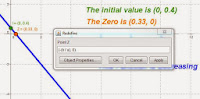
- Today I figured out the coordinates for my zero. I also edited my y-int and zeros conditions.
- I feel so proud of myself for figuring out the rule of the zero on my own. I dont know why but that was something i was having a hard time with and i got it!
- Entering them properly: Benefit: To get them to work, they had to be very careful about where to put brackets, about using only variables that were already defined, and of course to not make any typos.
- I had trouble with the y-intercept and the zero. Turns out, in both cases, I wasn't putting the brackets at the good place!
- OH MY GOSH!!!! It works!!! FINALLY!! Okay, so my mistake was sillly, I had written my P like this: P = (t, a sqrt(b(x-h)))+k I had put my last bracket in the wrong place. It is now: P = (t, asqrt(b(x-h))+k).
- With today's class though, I was able to know what to do and come with this product! What bothers me with this one though, is that the y-intercept doesn't seem right. The rule is what we usually use I guess, but the number geogebra gives me in the text doesn't seem correct! I'll try to find what the simplified rule is and write that instead of the big thing ( y= a*sqrt(b(x-h))+k )

- Conditions:

- Finding them: Benefit: This was very challenging for everyone. They've never had to do this before - systematically list all the possibilities for a certain math situation. I used to give out all this information for free, but no more. This stretched their algebra minds, no doubt.
- .I have to say one of the toughest part was figuring out when my text box should appear or not appear. It can get very complicated. I noticed though that when the theres a y intercept text box need's to show up it's the same as when a theres a zero textbox; the only difference being the parameters used.
- I made domain, range, function is increasing/decreasing, y int, and now I am working on the zeros but I am having trouble figuring out what to write as conditions for zeros to appear.
- The longest part about the texts was actually finding WHAT the conditions were. This is why making students use geogebra helps them understand how the function actually works and it's like having animated notes you can use to study with.
- I am SO SO SO SO exited with this last version:) I have my increasing and decreasing in however i also made the function change colour according to whether or not its decreasing! i did look at the vt for help but i must say that i did learn a few things on my own! like at first i accidentally made the line only appear when it was decreasing so i needed to play around with it until i was able to make it change for both:) so exited!
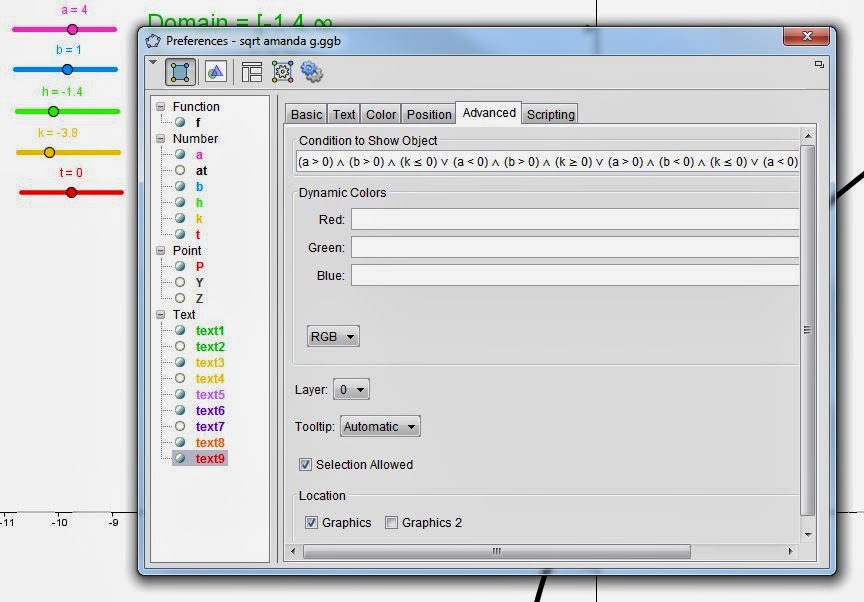
- Entering them properly: Benefit: Logic! Boolean operators! Truth! I never even got to teach this before!
- I was really happy to have figured out how to get my conditions right for my text that I did a happy dance in my head. So I figured that a>0, b>0 and a<0,b<0 means that it will increase and if a<0,b>0 and a>0, b<0 it will decrease. I was really happy.
- So for the y textbox in this example it was (h≥0&&b≤0)||(h≤0&&b≥0). The zero text box was the same thing except with k and a.
- Expression for the moving point P

- Finding it: Another step up the ladder of abstraction. That t-slider may well be their first opportunity to see a letter as a number whose value is varying, because that's literally what's happening as they move that beautiful little dot along. And that's not the same thing as a variable. Some letters are more variable than others. Not to mention that that moving point P was really a preparation for the next big project for physics about projectiles.
- Because of our last ggb assig nment i was able to figure out that point P was x as t and then the entire rule represented y (t as x).
- i had no problem with entering the rule and the 4 parameters but when i entered point P with t-slider the point P does not always stay on that functions line segment, im not sure what could be the problem. So far everything seems to be simple since we have done similar to this in the linear function except slider-t.
- Entering it properly: Benefit: Again, being careful with the brackets, and also getting the big picture after 3 or 4 functions.
- like i had said i have no problems with the parameters but i did have a problem with correctly adding point P with slider t and making it follow the line but with help from you we have noticed that it was tiny mistake in the way i had written my rule when i was entering the coordinates of the point P

Other benefits that I honestly wasn't even expecting:
- Doing one function would have been good, but doing several has allowed them to get a bigger picture. Some used their older assignments to figure out what to do in the new one, and saw patterns emerging.
- Engagement: There are some students who are definitely more engaged doing this than anything else. Some students had 10 or 11 versions before they finished. It's addictive. Even when it's not working. Especially when it's not working.
- Each time they do something they can check it right away. And that involves action, ie moving a slider, which then causes another action ie a colour change - it's like watching a movie!
- Opportunities now to talk about why different formulas work ie |t - h| and |h - t| give same result
- Opportunities for eloquence - eg they all input this for their formula for the x intercept of the square root function:
, which is completely correct, but not very pretty. I get to ask them which formula they'd rather type in, the one above, or this one:
, and by the way this is why we simplify algebraic expressions.
- Opportunities to talk about presentation - lining up your sliders so they're nice and neat, colour coding, using checkboxes to not crowd the screen
And here's more general feedback:
This was a great way to learn. I was able to see how the parameters affect each other and how it affects the function.
I feel that these assignments are really helpful for making sure we understand the concept. It allows us to put what we learned in class and in voice threads to use in a very creative way. I can't wait to see what else we will be doing with geogebra.
I am happy to be done and i have realised that this geogebra was similar to the other one except that there were more conditions to show objects and more rules about certain intercepts or zeros that we needed to enter. But by doing all these things i have learned more about the square root function and my understanding has been increased about what happens to the function when certain parameters are either negative or positive and so on. i'm really happy i finished it on time ( i have an english response that has been due for a week, so you should be quite happy, i'm not very good with homework)
Pushback:
Finally: I had a bit of pushback. A group of students asked to meet with me to talk about all the geogebra they've been doing. Their concerns were that they were getting too dependent on the software and were not developing their algebra skills. They pointed out that they can't use it on their tests, so they feel unprepared for them. Really important input! Then another student approached me and mentioned that they would rather have more notes and less geogebra. Part of me says "Listen to your students, they're your eyes on the ground" and the other part says "They're not used to working this hard or doing this much independent thinking, let them get used to it."
Well, for the time being, they've got one more geogebra project to do, and that's the big one, the one I've been thinking about since last spring - the physics/math virtual manipulative project. After that, I'll give them a geoge-break. But till then, I'm full steam ahead, because there's just too much great stuff happening that's telling me this is all worth it.
Tuesday, November 19, 2013
Twitter is the New Staff Room
I used to work in a school that had about forty teachers. Forty teachers, that is, and one staff room. Which meant that teachers from every department shared one big, giant, open room. Now, many years after I left, I realize that, as it turns out, we shared a lot more than that. Today, I find myself missing it, and looking for a close substitute in, of all places, Twitter.
The Great Big Staff Room
Back then, the fact that there were no walls between our desks made it easy for us to know each other, at least on some level. Whether or not we taught the same subject, or even ever had a full conversation, we eventually gained a sense of the people with whom we worked. That happened a little bit everyday, in the bits and pieces that we caught in walking past someone's desk and saying good morning, or happening upon a juicy conversation amongst a gaggle of teachers, or noticing someone's new haircut. It happened whenever we watched each others' reactions to the unintentionally hilarious and exasperating intercom announcements. It happened when someone needed to vent, or to share good news, or bad news, or when something truly dreadful was happening in the world, like 9/11. That staff room gave us, over time, a sense that we were all in this together, whatever "this" was at the time.
Not everyone liked it that way. Some people found the noise made it hard to concentrate, and others felt that it was a place where everyone just whined and complained. Not me. I loved that staff room. I honestly looked forward to walking in there every morning. I didn't love everyone in it, and I'm sure there were people who didn't love me, but I loved the feeling of being a part of something. (And, okay, there were people there whom I loved.)
As teachers, we also shared our craft, and also in a gradual, organic way. My department head and mentor, Maureen Moore, had a rich vocabulary and no-nonsense approach to teaching that definitely left a mark on me over the years. She also supported me and all my ideas so enthusiastically that I couldn't help but grow in confidence as a teacher working next to her. Another huge influence for me was a young teacher named Christie Brown, whose brilliant innovation and early adopting of ed tech is responsible, I think, in large part, for my love of ed tech. And of course, there was Armand Laderoute, a retired principal who replaced me when I was on maternity leave and just never left. He was a master teacher AND impersonator of other people. A nod of the head from him and you knew you were doing something right.
But I don't remember a heck of a lot of intentional subject-specific or cross-curricular collaboration happening, although I'm sure it did, probably more so after I left and the QEP came into effect. Mostly I remember people working together to plan staff events or school events. Certainly the potential for collaboration was there in buckets, because you only had to walk over to someone's desk to get it going. Now that I look back, it seems like I missed out on a huge potential for co-teaching.
It wasn't all about the room...
The subtle yet abiding team spirit in that staff room didn't only come from the lack of walls. It also came from the specific combination of people who inhabited it. I know for certain that it came from those people, because when the people changed, the cohesion changed. As it turned out, not only had we shared a room, but we also shared a common affinity for working together, and including as many people as possible in that endeavour.
Well that staff room's long gone, and anyway, now I work online, so there's no actual staff room for me to bask in. And I am privileged to work with a staff of the most inspiring and supportive educators in Canada, but we almost never see each other. So fortunately, there's Twitter. Dear merciful heaven, there's Twitter.
The Twitter Staff Room
On Twitter, I get to choose who's in my staff room. I can happen upon juicy conversations. I can hear peoples' reactions to things. I can get a sense of people based on their tweets, who's in their staff room, and how they respond, or don't, to me. I vent, share, or listen to others who need to. I get to be there for a friend who needs help carrying a burden.
I laugh at jokes (oh my goodness, so much laughing, just #saidnoteacherever and #overlyhonestmethods alone are enough).
I have people whom I could call mentors, but it's probably more accurate to say they inspire me, and not all in a math teacher way - some for teaching in general, pure and astonishing math skills, communication, ed tech, some just for how they interact with and help others tirelessly.
And now, despite the fact that we're not even in the same country, let alone the same room, I'm collaborating with all kinds of people all the time, and again, not always just about math (okay usually). But #bettertogether is my favourite hashtag, because it speaks to what I think I always believed, even way back in that big room.
And the learning, dear heaven, the learning. That's what I truly love, that I get to keep learning, and alongside other people who love to learn, which, as a teacher, is, I feel, is the first and best thing to live out in full view of my students. I don't mind if they forget the math they learned in my class, but I do so want them to follow their inspirations, do what they love, and share it with the world, so that's what I do. On Twitter.
And there are even some people on Twitter whom I love.
So even though I have fond memories of The Great Big Staff Room, and the people in it, for the time being I'll settle happily into my own little corner of the Twitter Sphere, with my pot of tea, my webcam, and my tweeps. All I'm missing is those intercom announcements. That's another blog post.
The Great Big Staff Room
Back then, the fact that there were no walls between our desks made it easy for us to know each other, at least on some level. Whether or not we taught the same subject, or even ever had a full conversation, we eventually gained a sense of the people with whom we worked. That happened a little bit everyday, in the bits and pieces that we caught in walking past someone's desk and saying good morning, or happening upon a juicy conversation amongst a gaggle of teachers, or noticing someone's new haircut. It happened whenever we watched each others' reactions to the unintentionally hilarious and exasperating intercom announcements. It happened when someone needed to vent, or to share good news, or bad news, or when something truly dreadful was happening in the world, like 9/11. That staff room gave us, over time, a sense that we were all in this together, whatever "this" was at the time.
Not everyone liked it that way. Some people found the noise made it hard to concentrate, and others felt that it was a place where everyone just whined and complained. Not me. I loved that staff room. I honestly looked forward to walking in there every morning. I didn't love everyone in it, and I'm sure there were people who didn't love me, but I loved the feeling of being a part of something. (And, okay, there were people there whom I loved.)
As teachers, we also shared our craft, and also in a gradual, organic way. My department head and mentor, Maureen Moore, had a rich vocabulary and no-nonsense approach to teaching that definitely left a mark on me over the years. She also supported me and all my ideas so enthusiastically that I couldn't help but grow in confidence as a teacher working next to her. Another huge influence for me was a young teacher named Christie Brown, whose brilliant innovation and early adopting of ed tech is responsible, I think, in large part, for my love of ed tech. And of course, there was Armand Laderoute, a retired principal who replaced me when I was on maternity leave and just never left. He was a master teacher AND impersonator of other people. A nod of the head from him and you knew you were doing something right.
But I don't remember a heck of a lot of intentional subject-specific or cross-curricular collaboration happening, although I'm sure it did, probably more so after I left and the QEP came into effect. Mostly I remember people working together to plan staff events or school events. Certainly the potential for collaboration was there in buckets, because you only had to walk over to someone's desk to get it going. Now that I look back, it seems like I missed out on a huge potential for co-teaching.
It wasn't all about the room...
The subtle yet abiding team spirit in that staff room didn't only come from the lack of walls. It also came from the specific combination of people who inhabited it. I know for certain that it came from those people, because when the people changed, the cohesion changed. As it turned out, not only had we shared a room, but we also shared a common affinity for working together, and including as many people as possible in that endeavour.
Well that staff room's long gone, and anyway, now I work online, so there's no actual staff room for me to bask in. And I am privileged to work with a staff of the most inspiring and supportive educators in Canada, but we almost never see each other. So fortunately, there's Twitter. Dear merciful heaven, there's Twitter.
The Twitter Staff Room
On Twitter, I get to choose who's in my staff room. I can happen upon juicy conversations. I can hear peoples' reactions to things. I can get a sense of people based on their tweets, who's in their staff room, and how they respond, or don't, to me. I vent, share, or listen to others who need to. I get to be there for a friend who needs help carrying a burden.
I laugh at jokes (oh my goodness, so much laughing, just #saidnoteacherever and #overlyhonestmethods alone are enough).
I have people whom I could call mentors, but it's probably more accurate to say they inspire me, and not all in a math teacher way - some for teaching in general, pure and astonishing math skills, communication, ed tech, some just for how they interact with and help others tirelessly.
And now, despite the fact that we're not even in the same country, let alone the same room, I'm collaborating with all kinds of people all the time, and again, not always just about math (okay usually). But #bettertogether is my favourite hashtag, because it speaks to what I think I always believed, even way back in that big room.
And the learning, dear heaven, the learning. That's what I truly love, that I get to keep learning, and alongside other people who love to learn, which, as a teacher, is, I feel, is the first and best thing to live out in full view of my students. I don't mind if they forget the math they learned in my class, but I do so want them to follow their inspirations, do what they love, and share it with the world, so that's what I do. On Twitter.
And there are even some people on Twitter whom I love.
So even though I have fond memories of The Great Big Staff Room, and the people in it, for the time being I'll settle happily into my own little corner of the Twitter Sphere, with my pot of tea, my webcam, and my tweeps. All I'm missing is those intercom announcements. That's another blog post.
Thursday, November 7, 2013
Followup of Student-Created Geogebras
My kids are about to submit their second geogebra assignments, which are on the square root function, but I haven't even gotten around to writing about their first ones, which were on the linear function, so here goes:
First assignments: The Linear Function
This was the assignment, and here are a few final versions, with only student initials as identifiers:

AB's linear, KR's linear, CC's linear, KR's animated linear,
As you can see there are variations in the presentation. Some use colours, some use text to guide the person using the ggb. Even with the same set of instructions, there was room in this assignment for individuality - and the animated one was just spectacular, especially to watch a quadratic function slowly forming from the trace of the linear one! I'm sure there's something cool to be done with that....later.
I gave a lot of opportunities for bonus points, the most time-demanding of which was to do the entire assignment again for a totally different function, either the quadratic the absolute value. About a third of my kids did it! Here are a few of those:
BC's quadratic, BC's absolute value, KR's animated absolute value

You're looking at the final versions, but equally fascinating and exciting to see were the various incarnations of each student's work as it evolved, as well as their reflections along the way. This was possible due to the digital portfolio tool I'm using, called Epearl.

Reflections:
Here are a few reflections (I know, there's a lot, believe me this is just a tiny fraction) - word for word, including spelling mistakes. I've highlighted things I found particularly interesting. Also, know that I'm not only showing the positives, although the overwhelming majority were. And a change in colour means a different student's voice.
I am hardly motivated at all to do this assignment; geogabra does not help me learn and only confuses me.
"The Absolute Value Function" is uploaded!!! It's amazing how perseverance pays off!!! After hours, literally, of trying how to make the zeroes and the initial value show up proprely on my absolute value function it works. The feeling you get after it finally works is unbelievable. The excitement to see it work proprely is amazing.
Overall, I enjoyed the assignment. It had its ups and downs, but in the end, it got done. I liked working with it because it wasn't too difficult and gave me a better vision when working with functions (oh, Geogebra). Projects like these are a great learning experience while also giving students creative control, which makes learning easier.
I have to admit, Geogebra is pretty cool....
I don't think it's helping me much with understanding this, as i already don't really understand much of what to do ......i haven't figured out how to add the t into the equation to have it move along my linear line....Figuring this whole thing out is pretty frustrating because i'm not sure how to add the t into the equation and how to make it move...Well now that i sort of figured out how to use the sliders, they work! and the whole project id sort of coming together. ...I did have troubles with this project... Learning to user geogebra to do this was frustrating me a lot. But i did learn from this.
Today i finally figured out what the y-intercept was! Its very simple after you realise what it really is, simply the k! i figured it out by accidentally putting in the formula (0,-k) and realized that was a reflection of the actual y-intercept and realised it will have to be (0,k). Feeling progressive! :)...
Throughout the whole process of making this geogebra I was able to get better at using the sliders. This was demanding work, but once you know what to do its easy!
I messed around with things and added animations to them and I got point P to leave a trace (: I'm happy to have figured out these things on my own....I'm finaly done, with 10 minutes untill the due date lol.
I kind of understand abs val functions more, but i deffinalty understand ggb more. It really took me until i had to compare my linear functiona nd my abs val function ggb's to understand all the formulas and for the most part i undersnat them now.
I am not really a person that is good in technology but I was proud of me when I was able to complete this assignment . This is probably not the prettiest/ funnest/ coolest geogebra in the world but I still like it because it made me discover a little bit of technology but also I learned a lot on the math involved. Looking at my function change direction while I was playing with the sliders made me see a whole new image of how this function is working. I may not really be good with geogebras but actually working with this program is a big help me understand better the math I am learning.
What I see:
First assignments: The Linear Function
This was the assignment, and here are a few final versions, with only student initials as identifiers:

AB's linear, KR's linear, CC's linear, KR's animated linear,
As you can see there are variations in the presentation. Some use colours, some use text to guide the person using the ggb. Even with the same set of instructions, there was room in this assignment for individuality - and the animated one was just spectacular, especially to watch a quadratic function slowly forming from the trace of the linear one! I'm sure there's something cool to be done with that....later.
I gave a lot of opportunities for bonus points, the most time-demanding of which was to do the entire assignment again for a totally different function, either the quadratic the absolute value. About a third of my kids did it! Here are a few of those:
BC's quadratic, BC's absolute value, KR's animated absolute value

You're looking at the final versions, but equally fascinating and exciting to see were the various incarnations of each student's work as it evolved, as well as their reflections along the way. This was possible due to the digital portfolio tool I'm using, called Epearl.
Reflections:
Here are a few reflections (I know, there's a lot, believe me this is just a tiny fraction) - word for word, including spelling mistakes. I've highlighted things I found particularly interesting. Also, know that I'm not only showing the positives, although the overwhelming majority were. And a change in colour means a different student's voice.
"The Absolute Value Function" is uploaded!!! It's amazing how perseverance pays off!!! After hours, literally, of trying how to make the zeroes and the initial value show up proprely on my absolute value function it works. The feeling you get after it finally works is unbelievable. The excitement to see it work proprely is amazing.
Overall, I enjoyed the assignment. It had its ups and downs, but in the end, it got done. I liked working with it because it wasn't too difficult and gave me a better vision when working with functions (oh, Geogebra). Projects like these are a great learning experience while also giving students creative control, which makes learning easier.
I have to admit, Geogebra is pretty cool....
I don't think it's helping me much with understanding this, as i already don't really understand much of what to do ......i haven't figured out how to add the t into the equation to have it move along my linear line....Figuring this whole thing out is pretty frustrating because i'm not sure how to add the t into the equation and how to make it move...Well now that i sort of figured out how to use the sliders, they work! and the whole project id sort of coming together. ...I did have troubles with this project... Learning to user geogebra to do this was frustrating me a lot. But i did learn from this.
Today i finally figured out what the y-intercept was! Its very simple after you realise what it really is, simply the k! i figured it out by accidentally putting in the formula (0,-k) and realized that was a reflection of the actual y-intercept and realised it will have to be (0,k). Feeling progressive! :)...
Throughout the whole process of making this geogebra I was able to get better at using the sliders. This was demanding work, but once you know what to do its easy!
I messed around with things and added animations to them and I got point P to leave a trace (: I'm happy to have figured out these things on my own....I'm finaly done, with 10 minutes untill the due date lol.
I kind of understand abs val functions more, but i deffinalty understand ggb more. It really took me until i had to compare my linear functiona nd my abs val function ggb's to understand all the formulas and for the most part i undersnat them now.
I am not really a person that is good in technology but I was proud of me when I was able to complete this assignment . This is probably not the prettiest/ funnest/ coolest geogebra in the world but I still like it because it made me discover a little bit of technology but also I learned a lot on the math involved. Looking at my function change direction while I was playing with the sliders made me see a whole new image of how this function is working. I may not really be good with geogebras but actually working with this program is a big help me understand better the math I am learning.
It was difficult figuring out how to get the point to move along the line but i looked at the
online manual of geogebra and figured it out
i am happy with myself for not slacking off as much as i usually would, i admit i was lazy
by not doing the last thing in the bonus section, but i am still impressed with my performance.
I learned a few things about geogebra throughout this assignment at first i was only doing the geogebra for one function but then with help from you i put in the general rule and from there if i had any problems i just looked at the geogebra file in sakai on important points of an absolute value function. It was a great project and i am excited to learn more about geogebra because it can help so much.
In my 3rd geogebra you can see that I animated both my a and k slider. I really love
that it changes it and can show how it changes by itself. I'm pretty sure it would look really
cool to show how something changes over time. The speed was at 1 at the begenning.
I found that to fast so I changed it to 0.1. I went to obeject properties for that specific
slider, went to the option slider and changed the speed (Refer to the screen shot's I
attached below).
I figured out so far how to make the colour of the line change depending if the slope (a)
is either positive, negative, or equals 0. When I had finally gotten it right I was so happy
I screamed. I think I might of scared my mom.
I'm almost done. Yay! I only have the little details left. Making everything pretty!
I'm almost done. Yay! I only have the little details left. Making everything pretty!
Wow. That's what I have to say. It's a lot of work, but a lot of fun. Challenging.
It makes your brain work to figure everything out and that's great. I have always
loved anything that put my brain to work, even if that meant that I got really
fustrated. In the end though it's worth it.
not even joking. It was like everything was perfect.
computer and coming back would help me see my problem and then I would be
It basically came down to the fact that I was sattisfied with my work personnally
and just felt that I had tripled checke deverything enough times. I felt peaceful. I'mnot even joking. It was like everything was perfect.
When I would finish part of the activity I would be happy it worked, this made the
activity extremely satisfying and even fun. Sometimes just stepping away from mycomputer and coming back would help me see my problem and then I would be
able to solve it without too much difficulty.
This was amazing. I feel like I now know a lot more about geogebra. It's a great way of
as I stated above.The universe has weird way's to teach us things about ourselves.
This was amazing. I feel like I now know a lot more about geogebra. It's a great way of
learning. I didn't think that it would be a style of learning that I would like, but I loved it.
Even though the goal was to make a linear function with many things, I learned so much
about geogabra while I was doing my assignment. I hope that we get to do something like this
again. It's fun, challenging, and creative. Emphesis on creative. Anything that is creative
I will fall in love with. I thought I was more orriented towards drawing on paper and things
like that, but being creative technology wise (using a program like geogebra) is absolutely
amazing. I didn't only learn about math and geogebra I also weirdly learned about myselfas I stated above.The universe has weird way's to teach us things about ourselves.
This was absolutly AMAZING!
What I see:
- Actual enthusiasm, not only from the kids who are always enthusiastic, and not only from the kids who have an easy time with math.
- The sheer variety of what they learned - be it tech or math - is mind-boggling.
- How many things they learned by accident, or just by playing around. Reminds me of me.
- Conviction in algebraic formulas - not only getting them right, but being able to believe they tell you the truth.
- Sophistication - seeing that some letters represent a variable and others represent a known value, and solving an equation that has no actual numbers in it, only variables and parameters.
- Soft skill development - walking away to get persepctive, organizing, taking initiative, persistance, using past successes to move ahead, metacognition.
- Resourcefulness - if you don't know something look it up online, or look at another example
- Student PLN's - one student found Steve Phelps' online geogebra manual and told me about how wonderful and helpful it was! I got to tell her that I ACTUALLY MET HIM! So now she and I are officially learning from the same person - how's that for a PLN?
Nuts and bolts:
- This takes them a lot of time. And I haven't exactly removed anything from the list of things I gave my students to do last year, except I've backed way off on the weekly checklists. The in-class activities have been replaced with ones that revolve around the geogebra assignment, as opposed to whatever voicethread they're currently supposed to listen to. More about that in a future post.
- This takes me a lot of time - I have been giving feedback on each and every version, so that by the time it's due, they can decide if it's done, not me. But Epearl makes it really easy to do that - it's like an interactive dropbox.
- Epearl also makes it really easy for them to share things with other members of the class, but I didn't have them do that for this assignment. Because I didn't know how to. Next time.
- I felt I had to give them a mark for this, because they worked so hard on it.
- I got the distinct impression that some of them would have done this for no marks at all.
What I wonder:
- What are the advantages of this? I mean really? I know it looks great and it feels great, but what's happening that I wouldn't happen without something like this?
- Are they doing deeper learning, or just different tasks superficially?
- How can I get them to make use of these tools that they have created? If they never look at them again, it's pointless. Or is it? Was the learning they did to make it worthwhile on its own?
On to the square root function geogebras, due tomorrow! Some were already in yesterday!
Subscribe to:
Posts (Atom)