Wednesday, January 9, 2013

Followup on exponential activity

So happy to be writing about math for a change! If only so that next year I have something to start with that is a little further along the effective-f2f-time continuum than this year.

So here's what happened:

I showed the first slide to all, had random volunteers find a few simple equivalent rules, to warm up before putting them in pairs to do the rest. After about 10 minutes, we talked.

Here are the screen shots of the different groups' sorting of the "exponential things":
amje

dafr
jali

mibo

pama

saca

tyelel


Observations during their work time:
  • almost no team was able to finish this first slide, and most started with the algebraic rules.
  • some gravitated to the graphs and sentences later. I think that for a lot of them it is a revelation that a graph represents the same thing as an equation. Or a sentence.
  • lots used geogebra to see if rules were equivalent, instead of working through the algebra
  • only two groups looked at the rule with e in it, and only one found its correct equivalent (at the left)
  • saw lots of discussing and questioning of each other, just a little of "miss, we're totally lost"
What I did:
  • I brought everyone back and went through the answers, pausing to let them either high-five or ask questions. They are really weak overall on evaluating things like .
  • Since we ran out of time, I decided to put the whole set of slides, answers and all, on this voicethread: and told them to look at it and leave their questions there, or answer other peoples' questions. Another opportunity to get their reflections, so that makes 3 ways.
  • In only one class were we able to get to the next activity, which was all english situations. I gave the hint that 3 of the 5 were equivalent, and immediately regretted it. Won't do that next time.
Next time: start with a slide that has only rules, then the next has rules and english, then the next has all three types of representation. Actually, it might be better to leave out graphs, not sure they helped at all.

It's only after doing this type of thing that I realize what I was trying to do. I made this activity up on a hunch, it seems, and now I what it could have done if I had done it better:
  • I want them to not only know THAT two things are equivalent but WHY they are - why they are algebraically and why they are realistically. It's not enough to get the algebra behind
  • , I want them to see that if something octuples every hour, it also doubles every third of an hour. I want them to be able to read that kind of info off the rule, like if the nbr of bacteria after x hours is , then they're tripling every half hour.
  • I pushed geogebra so much that now they rely on it too much. I have to find a way to balance things. Maybe I need to model using it more, as a way to verify their algebra, rather than to guess and check.
  • The idea that the base can be ANYTHING as long as you make the necessary adjustment to the coefficient of the exponent - is that too much for them at this age? Or will this help them out when we get to logs?
  • I think they need to sleep on things sometimes, so it will be interesting to see if anyone gains any insight tomorrow. Including me.
But the point is, I never even tried getting this idea across before, so even if it doesn't work, it has to have stretched some minds a bit. I haven't received any of their reflections yet. So looking forward to that, almost more than the math!

Tuesday, January 8, 2013

Activity for exponential functions

The continuing story of my flipped classroom, in which I try to make the best possible use of that f2f time:

I spent yesterday working on this activity for tomorrow's Science Math gr 11 class. It's another one that was inspired by Malcom Swan's Improving Learning in Mathematics, and I think it would fall under the category of  "Interpreting Multiple Representations", on page 19.

What I'm really looking forward to is the part where I ask them to reflect on what they learned doing this. I am giving them the option to do so either in private, via this week's checklist: (4th item):
) 

or on their blogs. I'm hoping to get more blog action this way, but I do plan to share the private reflections, and keep them anonymous. I just want them to know what each other is thinking!

Here's the activity: We're just finishing up with the exponential function, and I wanted to tie up a few loose ends, and give them time to chew on things. For instance, that when something gets doubled every hour, it gets root2'd every half hour. You didn't know that "to root2" was a verb, did you? It means to multiply something by the square root of 2. (In my world it does, anyway.)

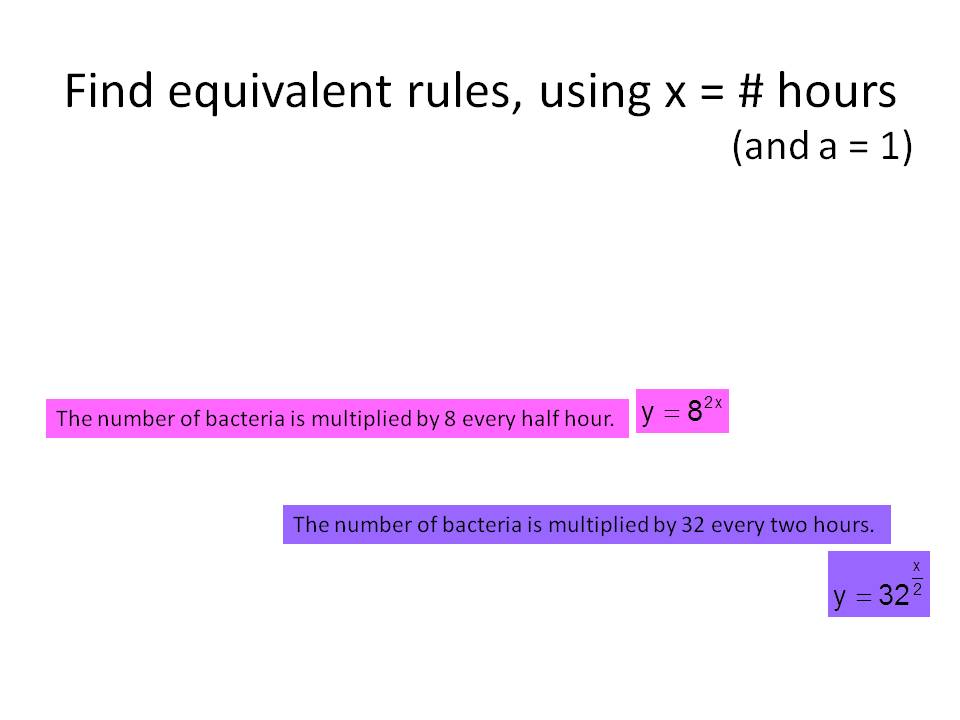
I'm going to give them this jumbled up slide of exponential things (I just couldn't think of another noun....) and ask them to sort them by which ones are equivalent. Lots of  "things" here - graphs, function rules, sentences. I plan to put the kids into small groups, then gather them back every few minutes. I'll ask them to use the nifty new highlighter pens in our virtual classroom.


But this is what I'm really getting at. Equivalent situations, ie. that you aren't locked into a base of 2 just because the problem says something doubles. The next sequence of slides is all about getting them to be able to move easily between these equivalent representations, not only from algebra to english, but from algebra to algebra, and english to english.


Here's the full set of slides, with answers. I'm thinking that I will go over the answers to the first jumble, but then let them sleep on the next set. We'll see how it goes. The thing about these types of activities is that they sometimes go in a direction you hadn't thought of. And they as a result end up taking either way less or way more time than you had anticipated. It certainly keeps me on my teaching toes!


Tuesday, January 1, 2013

Our Mother's Books

I love ebooks, but I also love the real ones, and every time I have to buy a new book, I am torn. This holiday, something happened that made me really appreciate the real ones. I and my four siblings were faced with a difficult task that left a mark on us all, and I don't think it would have done so if not for real books, with real paper, and dust, and handwritten notes, and of course, that old-book scent.

What happened was that in order to accommodate our mother's care team at the residence where she lives, we had to free up some space in her room. And that meant books had to go.

Marion Rae McLaren
Our mother was a librarian. She loved books, history, antique furniture, and her 5 kids. Everywhere she has ever lived would most accurately be described as a library with nice furniture in it. Our mum had every kind of book imaginable - all the Time Life series', science references, World Wars I and II, The History of Flight, the history of probably the entire world, Birds of North America, the Royal Family, Bibles, Bible History, Films, Lady Diana, complete works of Shakespeare, Jane Austen, Joseph Conrad, Charles Dickens, Winston Churchill, you name it. Not to mention all the magazines to which she subscribed - Time, Newsweek, The Economist. We rarely, if ever, had to go to the library for research.

Over the years, we have had to move our mother several times, due to her declining health, and with each move, her world has shrunk a little more, both the physical living space and her memory. Each move has required that we remove more of her things. Some we have distributed among the five of us, but most we have had to give away. We've had to pack up quite a few boxes of her beloved books, her Franklin Mint collections, fine china, and beautiful linens, keeping only those things that we felt she would want to keep, and also those things that we identified most closely with her. It's been a kind of slow and painful filtering process, most of which she mercifully missed. The last move was three years ago, after which we were down to two bookcases (each way overstuffed, with sagging shelves), one antique chest of drawers, one antique mirror, a tv, a CD player, a lovely old armchair, and one side table that was made by her father, our grandfather, a country gentleman in the finest tradition.

This holiday, the physiotherapist needed us to remove, among other things, one bookcase, which in this case meant removing roughly the equivalent of two bookcases-worth of books. As has always happened when we have had to go through this, we found ourselves falling into a pattern. We began by industriously going through the books, sorting them into two piles: give-away or keep. But every few minutes, someone unearthed a book that made us all stop, gather, and remember. This slowed us down quite a bit, but even though we had a limited window of time, we allowed ourselves this luxury, knowing that this was probably the last time we would do this.

Sometimes we gathered over a book with a name and date handwritten in it:

Mum's writing in
The Complete Works of Shakespeare
(note the price)

Mum's writing in Pickwick Papers,
a gift to her brother, Alex


Sometimes it was a book we remembered reading ourselves. I found the book on Stonehenge that I had used for a project in elementary school. My siblings paused over The Rise and Fall of the Third Reich, which they were all surprised to learn each had read at different times - and I mean this actual copy of it. My sister and I wondered how many other people had read The Double Helix after plucking it off their own living room bookshelf. We found comfort from the pamphlets and travel books she brought back from her trips to Europe and Asia, knowing that long before her world was reduced to this tiny room, she had realized a lifelong dream of travelling. After repeating this cycle of sorting and gathering many times, we eventually managed to finish.

By then, the overall effect on us was a sense of being steeped in a rich broth. By the end of the whole endeavour, we are all freshly imbued with our mother's intelligence, her passion for history, her love of reading, and her deep abiding devotion to us.

I'm not saying she is now reduced to her books in our minds. Of course, the books don't tell the whole story of our mum -  that as a girl she first saw The Wizard of Oz in a movie theatre, that she spent a few years being a career girl in New York City, that she raised the five of us virtually on her own, put us all through University, did her Master's degree at night after working all day, even took some math courses that tortured her but that she got through, that she was a news junkie, she survived an abusive mother and absentee husband, she was a snappy dresser, she loved M*A*S*H*, and she quit smoking just before retiring. Or that she was always enrolled in some continuing education course, or presiding over the St. James Literary Society, providing us all with an authentic model of a lifelong love of learning.

But the books do tell a part of her story, and our story. Sometimes, things, concrete things, do matter. I wonder how, or if, any of this could have happened if her entire collection had been in digital form. There would have been no need to go through anything, because digital books don't take up space. The five of us wouldn't have had to be there at the same time to mutually decide anything. There would have been no handwriting, or dusty old library scent, because there would be no pages to hold it. And I don't know how it works with borrowing books from someone's e-reader, but I bet it's not free, and it's not as cool as finding the actual book you and your sister both read, and that your mum read too.

In fact, I wonder what collection of mine would my own children have to go over so that they came away with a sense of what I loved in this life, what I made time for even when it was really hard to. And what about their kids? What are we leaving behind that tells our loved ones who we were, and does it even matter?

Well, I know it mattered to the five of us that because of our mum and her books, we were all there together, just the five of us, if only for a short time. And because of the memories those books held,  it was like Mum was there too.


Sunday, December 23, 2012

The Ten Stages of Flip

Remember how facebook introduced timeline a while back? Whatever your reaction to it, just consider that in a few years, people on facebook will be able to look back at the story of their own lives, the story that they wrote as it was happening, which, let's face it, will probably be way more accurate than any autobiography ever written.

This post is kind of my timeline since I started flipping. I looked back at all my posts since that first day, and it was quite the eye-opener, even though I wrote them all and I was there for the whole saga. I think it's crucial for everyone, flippers and critics alike, to let time enter into the discussion. You have to look at it all on a timeline to appreciate it. Toss it all onto a time graph, as individuals, as schools, even the whole movement. For example, I see my professional growth like this:


What can I say, I'm a math teacher, I'm into graphs.

If we looked at the movement as a whole this way, we'd see that the name is starting to not make as much sense, for example, "flip"  is starting to be replaced by "Flip 101", since it's really just a starting point, for those of us who are actually doing it. New labels are emerging that reflect the collaborative and higher-order-thinking natures of the movement, like coflip and metaflip. But the thing is, real change is happening, and it started with teachers.

But some critics just don't seem to be patient. They want it all to be perfect right away. But hey, if someone said to you:
someecards.com - You there! Improve everything you do! And make it snappy!

.....what would YOU say? We all need time, time to think, regroup, absorb, debate, compare......to learn. And that's what happens after that first venture into the land of flip, you become a learner right along with your kids.

So here are my stages so far, just under two years in. Whatever speed you move at, and whatever order you do things, I hope you recognize some of these, and please feel free to add.

1. Awakening and Courage: You hear about flipping the class and can't get it out of your head, but it takes almost a year before you have the courage to try it. You make your first recorded lesson and assign it to your students to watch.

2. Let-down: Not all of them watched it. You are shocked. You mean there are kids who don't do homework?!? You assign the same text book questions that you have always assigned. Few requests for help, and those from the same kids who always ask for help. Those who didn't watch either keep a low profile and struggle with the work, or watch during class, if there's a device handy of course.

3. Persistence: Repeat until you can't stand the quiet and the loneliness. You acutely feel the need to interact with your students over anything, preferably the content, to discuss, to hear their thoughts, to straighten out all the things that surely need straightening out.

4. Stirring it up: You start a class by asking if there are any questions from the previous night's lesson. There are a few. You think - this is not so different from traditional, it's the same few kids watching the video and asking questions. What's changed? Why am I doing this again?

5. Connecting: A student asks for help. And it's a good question. It's the kind that you wish every student would ask. It's not just Mrs. how do I do this, it's Why is it this way and not that way. You help them out. You really help them out. You see exactly where they need help, because you're having a conversation with them about it. You realize that even though you only helped one kid, it's such a powerful exchange that you are addicted to it. You wonder why this is the first time it's happened, even though you've been teaching for over 20 years.

6. Widening the radar: You start to initiate conversations with other kids, rather than wait for them to do it, because you know that most of them would rather not even be here, let alone talk to you about how they can't do the things you're asking them to do, which by the way, they don't want to do those either. You find you're getting to know these kids for the first time since they've been in your class. You feel a bit ashamed when you think of all those who've slipped under your radar over the years.

7. Speeding up/down: The stronger students begin to move ahead and ask for the next lesson before it's ready. You are like a deer in the headlights. Ummmm....do you have any other homework? you ask sheepishly. That night you spend a boatload of time queuing up the next few lessons and assigned work. You make it all available to them, from a website that you've only now understood what it's for, a content management system, or CMS. You start saying things like CMS. You try to sound casual, like, oh yeah, I just put it on the CMS, whatever.

8. Keeping track:  Since they're not all getting things done at the same speed, you realize you need to keep track more than you ever needed to before, but you can't keep up with the data. You start to use another website to do that, a wonderful one called google drive, and it is wonderful, for it is google drive. You start to say things like "I uploaded it to google drive" or "Did you update the checklist on google drive?" for you are now making these things called google forms. Your friends start to call you a technological genius. And stop listening to you because they think you must be some kind of technological genius, and anyway, they "don't have time" for all that tech stuff. You start to feel all alone.

9. Deepening thoughts: You feel like your class is becoming a ragtag band of math wanderers, then suddenly you remember a class activity that you were all fired up about 3 years ago from a workshop but that you never fit  into your class. You spend your evening designing it down to the last detail. Then you worry that it will only take 5 minutes of class time, so you design 2 more activities just in case.

10. More aha-ing: The first activity takes the whole period, because it was a good one, a REALLY good one based on research by Malcolm Swan, that got all of them talking about things you wanted them to notice....and things you didn't even think of, but are really awesome that they're talking about. With you. And each other. So now, during your class, there are conversations going on. About all kinds of stuff, including math.

I know, I know, I said ten...oh well:

11. Community: You join twitter and go through the ten stages of twitter. Then you join The flipped Network and start meeting other teachers. You stop feeling all alone.

12. Awakening of creativity: Everytime you take a shower 2 dozen more ideas come to you. You forget most of them by the time your hair dries. The one you remember you spend the rest of the evening putting together. You resolve to either stop taking showers or write these ideas on the wall with a grease pencil. (Thanks Kate Nowak.)

13. Reality: Your family alerts you to the complete lack of clean underwear anywhere in the house, and to the strange cryptic messages on the bathroom wall.

Bonus steps:

You re-watch your first video.

You begin searching for a large rock to crawl under because it is just so awful. Just. So. Awful.

And now the next stages, which will include making my "lessons" shorter and less and less necessary, another thing I can't get out of my head since hearing Graham Johnson speak at the Global Math Department webinar. Thanks, Graham. And thanks facebook!

Friday, November 30, 2012

Maybe we should call it the shifted classroom:

Please click through all the slides, this has consumed me for about 2 weeks. It's a visual description of the flipped class AND its benefits. Comments and feedback hysterically welcome (in case the scribd version doesn't work for you, see the slideshare version below): Flip o Graphic


Note: The scribd version doesn't seem to be working in chrome or firefox, so here it is on slideshare:

Sunday, November 25, 2012

Wanted: Ideas for "good" help

The very day after the class I posted about here, I continued in my quest to control my explaining habit. Math help was out of the question but I used the rule of thumb that they could get math help from a peer without any penalty. But I needed something to do....I mean I am the teacher! Thankfully, I found a few things I could do with a clear conscience. And if you have anything to add to the list, I would be eternally grateful:

Be a catalyst:
  • One student told me he got his solution in two different ways but didn't get the same result. He asked if I could help him find the mistake, because he had tried and was getting frustrated. I figured it would be better if he compared his results with someone else, so I asked for volunteers to put their results on the board. Not all students have the confidence to put themselves out there on their own initiative, so my role was to be the catalyst. Once one or two graphs were up on the board, the rest followed more easily. Comparisons were made, discussions ensued, mistakes were found. Strength in numbers! 
Help them find the hole:
  • Whenever I was asked for help, I started by saying "Tell me what you've done so far." First off, this helps them organize their thoughts. Also, while they do this, I have to be constantly asking questions, like, how did you get this result, how did you verify these calculations, what do you know, what are you looking for...and if the answer to any of these is I didn't do that or I don't know, it helps them zoom in on the hole in their work ethic, not their math.
  • Even those who are marching along at a good clip can benefit from explaining their work, to me or to a peer, because that can be a practice run at how they will present their solution.
Get them modelling:
  • One student, let's say her name is Claire, listened to one group's explanation of their procedures, then later, while working with a different group, said she hadn't understood the first group's work, and so had figured out her own way. I asked Claire to explain her way to the second group. That group then benefited not only mathematically, but emotionally. She used their own language, AND it was great modelling - here's someone who got stuck, tried out something else, then persisted until she found her own way. I can say "persist!" until the cows come home, but when they see a peer actually doing it, it's got gravitas.
Give presentation guidance:
Nice colour coding by a student!
I made suggestions for how their final work might look:
  • headings for sections
  • colour coding
  • introduction/conclusion paragraph
  • outline procedure first then give details
  • validate and show your validation
  • do the whole thing paper-free


Offer technical help:
  • A student was trying to read points from his graph, which he had created from excel using just a few data points. From his responses to my "find the hole" questions, I guessed that his graph didn't have the accuracy he needed (remember I can't see them, or their work instantly), so I suggested he do it using geogebra, which can produce a graph from a rule. I had already introduced geogebra, and I had told them they could use it for this problem, but I think he was stuck in a rut, always using the same tool, never considering that another might be better for this case.
  • Some were working on their final presentation and needed help like how to take a snapshot and paste it into a word doc or ppt, or how to get proper math notation and symbols into the same.
Final thoughts:

  • Of course, it all depends. Pretty much all of the above ideas came to me during and after a class with a highly motivated and active core group of students. They're the spark plugs in the problem-solving engine. But in a class without those spark plugs, where no one ever asks you for help, or no one offers help, none of this would happen without additional prodding from me. Which makes it all feel so old-school to me, so do-this-because-I-told-you-to-not-because-you-want-to. Maybe that's just a question of finding problems that are more engaging for that particular group....

More suggestions?

  • If you have any other ideas of what kind of help teachers can give students that will truly help them tackle problems, other than explaining the entire solution to them, I'd love to hear them!

Wednesday, November 21, 2012

Real bullying

So many tv shows and movies portray bullying as an overt, intentional, and violent act that's easy to spot. And it's easy to distinguish the bullies from the bullied. My own experience with it, as a kid and as a parent, is very different. Sometimes it's more about what doesn't happen, and what you don't see. And more importantly, on some level, at some point, everyone participates on the bullying side, whether or not they meant to. I'll explain with a few examples from my life:

Conflicting agendas

When my son was in grade 3 or 4, at a school I'll call ABC School, he witnessed his best friend being bullied. Kevin (not his real name) had hurt his leg on the playground, and as he was crying from the pain, some kids made fun of him and even kicked his leg, which, as it later turned out, was broken. My son came home extremely upset, told me about it, and I wrote a note to his teacher informing her of what had happened. I figured someone should know about it, and I wanted my son to know that he had done the right thing in telling me. I remember ending the note with something like "I know ABC school does not tolerate bullying," because that was the message that had come home in writing prior to this incident.

In he went the next day with the note. I went to work. Mid-morning, I received a phone call from an irate principal of ABC School. I will never forget this conversation as long as I live. I was scolded for using the word bullying, because that word is so strong and so negative, and could give the wrong impression of a school, so please do not use this word to describe what happened. I responded by saying that my son had certainly seen SOMETHING, and that I thought the school would want to at least find out more. He said, "I already asked Kevin. He said nothing happened, there was no bullying." Gee, I can think of a good reason why a bullied kid would lie about that, but anyway, that was the principal's story and he was sticking to it. He clearly didn't want bad publicity for ABC School.

Meanwhile, a very different reaction was taking place in the realm of the teachers. When my son came home that day, he told me that at morning recess, the teachers had gathered all the kids from the whole grade into one class, and no one was allowed to leave until the bullies confessed.

And they had! Interesting note - based on the timing, I was pretty sure these confessions happened at the same moment the principal was on the phone telling me no bullying had happened.

Quite a difference between the principal's reaction and the teachers' eh? Clearly, the principal's agenda conflicted with the teachers'. And Kevin's, and my son's, if kids that age can even have them. Being able to see what had happened was just not possible for someone who needed to not see it.

Bullying by compliance

Soon after my daughter started attending XYZ high school, she told me about a girl in her grade that everyone called, I'll say, Frog. The consensus was that she was obnoxious and unattractive. But she didn't seem to mind, in fact, she laughed whenever someone called her that. So no harm done right? Except that this girl was being dehumanized, and I was pretty sure it hurt, and that she was doing a good job of hiding it.

I was so upset to hear this, as a mother and a teacher, that I called the school, and told the vice principal about it. He was very kind, very professional, also very upset, and thanked me for telling him. He assured me he would do something about it. I'll never forget that conversation either, mainly because I had steeled myself for something entirely different.

Soon after that, I asked my daughter if anything had been done about it. She thought for a second and said, "Oh that must be what that talk was about in homeroom. The vice principal came in and told us that bullying is wrong and we should tell someone if we see it happening."

That was it. Now, I know he meant well, but let's face it, those words likely fell on deaf ears. How many times had they heard this? And why would they listen this time, especially when no one knew what specific incident had brought it on? But even more importantly, his voice didn't have the power to change anyone's perception. As sincere as he might have been, he just said what a vice principal is supposed to say. Even my daughter, a nice kid, who never called anyone names, still had the idea that no bullying had happened. So people were complying with not only the status quo, but with the perceived attitude of the victim.

Enter the age of the authentic voice

Last week @intrepidteacher tweeted this about one of his students:

It's an eloquent and painfully honest post by a brave student about being shunned, which is a form of bullying with which I am all too familiar. Here it is. Go have a read, I'll wait.

Now THIS is an authentic voice! It got my attention, it got the attention of a LOT of people on twitter, and you can see by the comments that it got the attention of OTHER KIDS! Imagine the relief, the shock, the introspection, the awareness, sensitization, well you get the idea, that arose from the writing, posting, reading, and reacting to this post!
  • This writer found out he was not alone in feeling this way
  • other kids found out what it felt like to be shunned
  • other kids found out that they were not alone
  • other kids had to face the undeniable fact that they were participants in hurting someone
  • teachers, administrators, and parents got a big eye-opening because this came straight from the victim

...and you cannot help but believe him, not only because of how it's written, but because there is nothing interfering with his message, no one spinning it or burying it or viewing it through a distorted lens for their own agenda. Ok, Jabiz tweeted it, but that's just more bravery.

Imagine if the girl in my daughter's high school had been given the opportunity to express her feelings like this? Imagine students in her school reading it, thinking, wow that's so mean of people to do that, and then finding out at the end of the post that she was a girl in their own class, and that they had unwittingly participated in her suffering? I can only hope that's happening right now in the school of this young man. And I can only hope that that poor girl at XYZ High has found out somehow that she doesn't have to play along with the bullies and laughingly shrug off hurtful comments.

More than ever, I am convinced that getting kids to write and giving them an audience might just be the best line of defense against all kinds of bullying, overt or otherwise. At least it's the best way to convince everyone, the bullies, the victims, and everyone in between, that it happens, it's real, and it hurts.