When I first started flipping my math classes, class time was agony for me. I could hear the crickets chirping, and I knew there had to be better things to get my students to do than the usual text book questions. But now, about two years in, I'm having a hard time fitting things into my class time.
What am I trying to fit in you ask?
Talking time:
I don't mean lecturing, of course, and I don't mean necessarily me talking, but I do mean a whole-class discussion. I want to create some sense of group cohesion, that we are a team, on a journey, and that part of the journey is getting to know each other in this math context. I don't want to go through a whole year with a bunch of people who feel no connection to each other. And yes, it's fine if all they have in common is that they worship their math teacher, I suppose I can live with that. But if, once they're done this course, they never speak to each other again, or never think fondly of the things that they did here, I have failed them in some way.
So at the very least, we spend a few minutes chatting, maybe about math, or maybe not. I like to start the class talking about something that they have done, like their comments from the most recent voicethread, or about some of their recent blogposts. Recently we laughed about some of the words we're using in our log studies, like logalicious, smooshing, de-logging, and they came up with a new one: to "Lion King" a logarithm. More about that in another post. But in coming up with our own funny language, we all said, without words, "We are us."
Working time:
This might be just a quick checkup on the basics, for example, I often have them all work something out on the eboard at the same time. This isn't only so that I can see if they're getting it, it's also a nice combo of individual work and group work - they're working on their own but they're checking out everyone else's work at the same time. And they love it! If they don't know what to do, they watch a peer's work unfold, and I can just get someone else to answer questions or explain as they're working. It's a great opportunity to get them talking about math in their own language. Here's how one group's work looked at the end, and by the way, not everyone started out knowing what to do, and we talked about scientific notation to boot:
Exploration time:
The goal of this time is to deepen their understanding, often doing group work. I'm not a huge fan of group work just for the sake of group work, but if it arises organically, as a result of a need to discuss, compare, gather info, then I'm all for it. There are a lot of people out there who are creating wonderful activities like this, for example, Dan Meyer, Kate Nowak, John Golden, or any of the people in the geogebratube.org community.
When I create my own, I use Malcolm Swan's great document as a guideline. Last week, I wanted to open their eyes to some details that they may have easily overlooked, for example, that log ab² is not the same as log (ab)². Here's the activity, complete with answers, which, by the way, I did NOT make available to them until they had struggled and suffered to my satisfaction:
Individual help time:
During this time, they are working on the items I've assigned via a weekly checklist, which means this is when they are likely to need help. My goal is to speak to every single person. This is the greatest time-hog of all. I cannot honestly say that I am reaching every student everyday, à la Jon Bergmann/Aaron Sams, but I do aim for that. I try to set things up so that if I'm not available, they can ask a peer for help. (So far, in the online environment, that hasn't really happened to my satisfaction. I think that is one thing that happens more organically in the brick and mortar class. That's another post.)
Just like in any class, there are some students who always initiate a conversation with me (Mrs. I need help with...), and some who never do. For those kids, I have my checklists (info that they send me during the week via a google form) at the ready. So if I see that Susie hasn't checked off the geogebra activity.....Susie, have you uploaded your geogebra? No? You need help? Or, Tommy, you haven't checked anything off for this week, what's up? Get it together man! (I don't actually speak to my students that way. Yes I do.)
The Big Picture
I'm not saying that I can fit all of these into every single class! Most of the time, I manage to fit in the talking and the individual help, with something else sandwiched in between. And that something else is constantly evolving. My hope is for that part of the class to live up to the goal set in this brilliant post by Robert Talbert, that is, to "focus class time on the stuff where they are most likely to get stuck and need their social network and a professor to help."
But that evolution can only happen with collaboration, unless you are immortal, or don't have anything else to do in your life like, say, take care of a family or watch movies and go for walks. It takes a boatload of time to create, try out, reflect on, and improve our classroom activities, and when we share, or better yet, create things together, or EVEN BETTER YET, COFLIP, we divide and conquer that time!
Showing posts with label flipping. Show all posts
Sunday, February 3, 2013
Mining That Face-to-face Time
Sunday, December 23, 2012
The Ten Stages of Flip
Remember how facebook introduced timeline a while back? Whatever your reaction to it, just consider that in a few years, people on facebook will be able to look back at the story of their own lives, the story that they wrote as it was happening, which, let's face it, will probably be way more accurate than any autobiography ever written.
This post is kind of my timeline since I started flipping. I looked back at all my posts since that first day, and it was quite the eye-opener, even though I wrote them all and I was there for the whole saga. I think it's crucial for everyone, flippers and critics alike, to let time enter into the discussion. You have to look at it all on a timeline to appreciate it. Toss it all onto a time graph, as individuals, as schools, even the whole movement. For example, I see my professional growth like this:
But some critics just don't seem to be patient. They want it all to be perfect right away. But hey, if someone said to you:
.....what would YOU say? We all need time, time to think, regroup, absorb, debate, compare......to learn. And that's what happens after that first venture into the land of flip, you become a learner right along with your kids.
So here are my stages so far, just under two years in. Whatever speed you move at, and whatever order you do things, I hope you recognize some of these, and please feel free to add.
1. Awakening and Courage: You hear about flipping the class and can't get it out of your head, but it takes almost a year before you have the courage to try it. You make your first recorded lesson and assign it to your students to watch.
2. Let-down: Not all of them watched it. You are shocked. You mean there are kids who don't do homework?!? You assign the same text book questions that you have always assigned. Few requests for help, and those from the same kids who always ask for help. Those who didn't watch either keep a low profile and struggle with the work, or watch during class, if there's a device handy of course.
3. Persistence: Repeat until you can't stand the quiet and the loneliness. You acutely feel the need to interact with your students over anything, preferably the content, to discuss, to hear their thoughts, to straighten out all the things that surely need straightening out.
4. Stirring it up: You start a class by asking if there are any questions from the previous night's lesson. There are a few. You think - this is not so different from traditional, it's the same few kids watching the video and asking questions. What's changed? Why am I doing this again?
5. Connecting: A student asks for help. And it's a good question. It's the kind that you wish every student would ask. It's not just Mrs. how do I do this, it's Why is it this way and not that way. You help them out. You really help them out. You see exactly where they need help, because you're having a conversation with them about it. You realize that even though you only helped one kid, it's such a powerful exchange that you are addicted to it. You wonder why this is the first time it's happened, even though you've been teaching for over 20 years.
6. Widening the radar: You start to initiate conversations with other kids, rather than wait for them to do it, because you know that most of them would rather not even be here, let alone talk to you about how they can't do the things you're asking them to do, which by the way, they don't want to do those either. You find you're getting to know these kids for the first time since they've been in your class. You feel a bit ashamed when you think of all those who've slipped under your radar over the years.
7. Speeding up/down: The stronger students begin to move ahead and ask for the next lesson before it's ready. You are like a deer in the headlights. Ummmm....do you have any other homework? you ask sheepishly. That night you spend a boatload of time queuing up the next few lessons and assigned work. You make it all available to them, from a website that you've only now understood what it's for, a content management system, or CMS. You start saying things like CMS. You try to sound casual, like, oh yeah, I just put it on the CMS, whatever.
8. Keeping track: Since they're not all getting things done at the same speed, you realize you need to keep track more than you ever needed to before, but you can't keep up with the data. You start to use another website to do that, a wonderful one called google drive, and it is wonderful, for it is google drive. You start to say things like "I uploaded it to google drive" or "Did you update the checklist on google drive?" for you are now making these things called google forms. Your friends start to call you a technological genius. And stop listening to you because they think you must be some kind of technological genius, and anyway, they "don't have time" for all that tech stuff. You start to feel all alone.
9. Deepening thoughts: You feel like your class is becoming a ragtag band of math wanderers, then suddenly you remember a class activity that you were all fired up about 3 years ago from a workshop but that you never fit into your class. You spend your evening designing it down to the last detail. Then you worry that it will only take 5 minutes of class time, so you design 2 more activities just in case.
10. More aha-ing: The first activity takes the whole period, because it was a good one, a REALLY good one based on research by Malcolm Swan, that got all of them talking about things you wanted them to notice....and things you didn't even think of, but are really awesome that they're talking about. With you. And each other. So now, during your class, there are conversations going on. About all kinds of stuff, including math.
I know, I know, I said ten...oh well:
11. Community: You join twitter and go through the ten stages of twitter. Then you join The flipped Network and start meeting other teachers. You stop feeling all alone.
12. Awakening of creativity: Everytime you take a shower 2 dozen more ideas come to you. You forget most of them by the time your hair dries. The one you remember you spend the rest of the evening putting together. You resolve to either stop taking showers or write these ideas on the wall with a grease pencil. (Thanks Kate Nowak.)
13. Reality: Your family alerts you to the complete lack of clean underwear anywhere in the house, and to the strange cryptic messages on the bathroom wall.
Bonus steps:
You re-watch your first video.
You begin searching for a large rock to crawl under because it is just so awful. Just. So. Awful.
And now the next stages, which will include making my "lessons" shorter and less and less necessary, another thing I can't get out of my head since hearing Graham Johnson speak at the Global Math Department webinar. Thanks, Graham. And thanks facebook!
This post is kind of my timeline since I started flipping. I looked back at all my posts since that first day, and it was quite the eye-opener, even though I wrote them all and I was there for the whole saga. I think it's crucial for everyone, flippers and critics alike, to let time enter into the discussion. You have to look at it all on a timeline to appreciate it. Toss it all onto a time graph, as individuals, as schools, even the whole movement. For example, I see my professional growth like this:
What can I say, I'm a math teacher, I'm into graphs.
If we looked at the movement as a whole this way, we'd see that the name is starting to not make as much sense, for example, "flip" is starting to be replaced by "Flip 101", since it's really just a starting point, for those of us who are actually doing it. New labels are emerging that reflect the collaborative and higher-order-thinking natures of the movement, like coflip and metaflip. But the thing is, real change is happening, and it started with teachers.
.....what would YOU say? We all need time, time to think, regroup, absorb, debate, compare......to learn. And that's what happens after that first venture into the land of flip, you become a learner right along with your kids.
So here are my stages so far, just under two years in. Whatever speed you move at, and whatever order you do things, I hope you recognize some of these, and please feel free to add.
1. Awakening and Courage: You hear about flipping the class and can't get it out of your head, but it takes almost a year before you have the courage to try it. You make your first recorded lesson and assign it to your students to watch.
2. Let-down: Not all of them watched it. You are shocked. You mean there are kids who don't do homework?!? You assign the same text book questions that you have always assigned. Few requests for help, and those from the same kids who always ask for help. Those who didn't watch either keep a low profile and struggle with the work, or watch during class, if there's a device handy of course.
3. Persistence: Repeat until you can't stand the quiet and the loneliness. You acutely feel the need to interact with your students over anything, preferably the content, to discuss, to hear their thoughts, to straighten out all the things that surely need straightening out.
4. Stirring it up: You start a class by asking if there are any questions from the previous night's lesson. There are a few. You think - this is not so different from traditional, it's the same few kids watching the video and asking questions. What's changed? Why am I doing this again?
5. Connecting: A student asks for help. And it's a good question. It's the kind that you wish every student would ask. It's not just Mrs. how do I do this, it's Why is it this way and not that way. You help them out. You really help them out. You see exactly where they need help, because you're having a conversation with them about it. You realize that even though you only helped one kid, it's such a powerful exchange that you are addicted to it. You wonder why this is the first time it's happened, even though you've been teaching for over 20 years.
6. Widening the radar: You start to initiate conversations with other kids, rather than wait for them to do it, because you know that most of them would rather not even be here, let alone talk to you about how they can't do the things you're asking them to do, which by the way, they don't want to do those either. You find you're getting to know these kids for the first time since they've been in your class. You feel a bit ashamed when you think of all those who've slipped under your radar over the years.
7. Speeding up/down: The stronger students begin to move ahead and ask for the next lesson before it's ready. You are like a deer in the headlights. Ummmm....do you have any other homework? you ask sheepishly. That night you spend a boatload of time queuing up the next few lessons and assigned work. You make it all available to them, from a website that you've only now understood what it's for, a content management system, or CMS. You start saying things like CMS. You try to sound casual, like, oh yeah, I just put it on the CMS, whatever.
8. Keeping track: Since they're not all getting things done at the same speed, you realize you need to keep track more than you ever needed to before, but you can't keep up with the data. You start to use another website to do that, a wonderful one called google drive, and it is wonderful, for it is google drive. You start to say things like "I uploaded it to google drive" or "Did you update the checklist on google drive?" for you are now making these things called google forms. Your friends start to call you a technological genius. And stop listening to you because they think you must be some kind of technological genius, and anyway, they "don't have time" for all that tech stuff. You start to feel all alone.
9. Deepening thoughts: You feel like your class is becoming a ragtag band of math wanderers, then suddenly you remember a class activity that you were all fired up about 3 years ago from a workshop but that you never fit into your class. You spend your evening designing it down to the last detail. Then you worry that it will only take 5 minutes of class time, so you design 2 more activities just in case.
10. More aha-ing: The first activity takes the whole period, because it was a good one, a REALLY good one based on research by Malcolm Swan, that got all of them talking about things you wanted them to notice....and things you didn't even think of, but are really awesome that they're talking about. With you. And each other. So now, during your class, there are conversations going on. About all kinds of stuff, including math.
I know, I know, I said ten...oh well:
11. Community: You join twitter and go through the ten stages of twitter. Then you join The flipped Network and start meeting other teachers. You stop feeling all alone.
12. Awakening of creativity: Everytime you take a shower 2 dozen more ideas come to you. You forget most of them by the time your hair dries. The one you remember you spend the rest of the evening putting together. You resolve to either stop taking showers or write these ideas on the wall with a grease pencil. (Thanks Kate Nowak.)
13. Reality: Your family alerts you to the complete lack of clean underwear anywhere in the house, and to the strange cryptic messages on the bathroom wall.
Bonus steps:
You re-watch your first video.
You begin searching for a large rock to crawl under because it is just so awful. Just. So. Awful.
And now the next stages, which will include making my "lessons" shorter and less and less necessary, another thing I can't get out of my head since hearing Graham Johnson speak at the Global Math Department webinar. Thanks, Graham. And thanks facebook!
Monday, June 11, 2012
Thank you, Quebec Ministry of Education, for Beaucoup de cool student projects!
In Quebec, up until 2 years ago, all grade 11 students were required to produce, by the end of the year, a math project, called the Independent Assignment. It was to be based on their own interest, of course related to math somehow, and it was to be done mostly during class time, in 10 sessions, with guidance from the teacher. This was so that it would be good training on how to do a research project as well. (We were given some excellent scaffolding for implementing this.)
I griped and panicked about how I would fit these project sessions into my classes AND still cover everything on time, for this was pre-flip, when classes were all me, me, and more me yammering away. But I dutifully had my students do the project anyway for the first time in the school year 2009-2010. They pretty much all made powerpoints, which was fine. The projects were great, and even though they had taken up a lot of class time and energy, I found it was worthwhile having my students do something that interested or inspired them mathematically.
Then I went to ISTE in Denver, and I heard about all the bazillion other tools there are out there. And I heard a casual reference to something called "flipping the class" during a session about something called "Twitter." Hmmmm", I thought, "interesting," blissfully unaware that, in that moment, my entire world had just been rocked to the core.
Well, back to reality, the next year, Quebec dropped the project as a requirement, but I decided to keep doing it, partly because, I really wanted to have some PBL in my course, but also because I really wanted to try out some of the tools I had heard about. That year's projects were a tiny bit more varied, I think I had one or two videos and the rest powerpoints. It had still been a challenge to fit in the sessions. Plus I started flipping late in the year, when many of the projects were already well under way.
This past year was my first full year flipping. And just like that, there was zero issue about fitting in the sessions. Class time was all about what THEY were doing, not what I was saying! I could discuss with them about their topic, they could discuss with each other, show what they'd found, experiment....I even had a period at the beginning of the year that was all about investigating the various tools, which was inspired by Terie Engelbrect's brilliant blog, which I had found on Twitter. Yup. Rocked to the core.
Well, it's two years after the government started it all, and here is the latest batch of projects, just handed in after a year of working on them in and out of class. The variety alone is blowing me away - voicethreads, videos, glogs, googledocs, prezis, AND powerpoints! If, two years ago, in Denver, you had told me that my students would soon be producing these kinds of projects, uploading them to their blogs, and never mind the fact that I have a blog and I'm embedding the projects on it....I would have looked around and said "Me? You mean me?"
Most of these are embedded, but some you have to click on the link to see the actual project. Enjoy! I know I did, in fact, I have this math rap song stuck in my head now:
Arnold's rap video:
Brett's intro video to his project:
:
....and the guitar math voicethread:
Emilie's googledocs presentation:

Kaily and the End of the World:
Katerina's sizes of infinity video....definitely channeling Vihart here! ;)
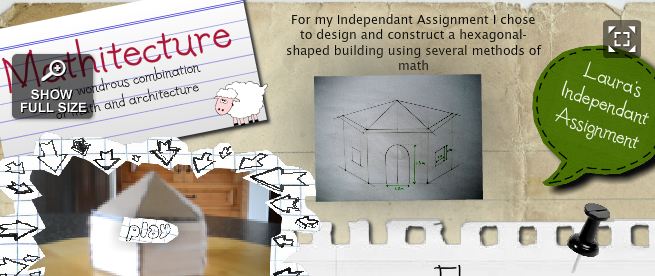
Laura's mathitecture glog:
Olivia's snowboarding prezi:
Ricky's sizes of infinity slideshare:
Taylor's energy glog:
Melissa's hockey math:
Joey's drum math:
In my dreams
So now off they go to CEGEP, which is the Quebec equivalent to college. A small, selfish part of me hopes that at least one of these students will next year submit a project using one of these tools, or something equally cool, to an astonished professor, who will then ask:
"Who are you really, and what is this amazing thing you have done, and where on earth did you learn how to do this?"
And they will say, "Oh I had to pick a webtool from a googledocs list, and learn how to use it so I could embed it in my blog, for my math teacher, Mrs. McGoldrick."
The professor will eventually regain the ability to speak, then he/she will exclaim "BLOG? GOOGLEDOC? How have you come to know all these wondrous things?"
And then he/she will learn about all these wondrous things, from one of my students, who will get to be their professor's teacher, at least for a few minutes.
How cool would that be? Beaucoup de cool. Merci MELS!
I griped and panicked about how I would fit these project sessions into my classes AND still cover everything on time, for this was pre-flip, when classes were all me, me, and more me yammering away. But I dutifully had my students do the project anyway for the first time in the school year 2009-2010. They pretty much all made powerpoints, which was fine. The projects were great, and even though they had taken up a lot of class time and energy, I found it was worthwhile having my students do something that interested or inspired them mathematically.
Then I went to ISTE in Denver, and I heard about all the bazillion other tools there are out there. And I heard a casual reference to something called "flipping the class" during a session about something called "Twitter." Hmmmm", I thought, "interesting," blissfully unaware that, in that moment, my entire world had just been rocked to the core.
Well, back to reality, the next year, Quebec dropped the project as a requirement, but I decided to keep doing it, partly because, I really wanted to have some PBL in my course, but also because I really wanted to try out some of the tools I had heard about. That year's projects were a tiny bit more varied, I think I had one or two videos and the rest powerpoints. It had still been a challenge to fit in the sessions. Plus I started flipping late in the year, when many of the projects were already well under way.
This past year was my first full year flipping. And just like that, there was zero issue about fitting in the sessions. Class time was all about what THEY were doing, not what I was saying! I could discuss with them about their topic, they could discuss with each other, show what they'd found, experiment....I even had a period at the beginning of the year that was all about investigating the various tools, which was inspired by Terie Engelbrect's brilliant blog, which I had found on Twitter. Yup. Rocked to the core.
Well, it's two years after the government started it all, and here is the latest batch of projects, just handed in after a year of working on them in and out of class. The variety alone is blowing me away - voicethreads, videos, glogs, googledocs, prezis, AND powerpoints! If, two years ago, in Denver, you had told me that my students would soon be producing these kinds of projects, uploading them to their blogs, and never mind the fact that I have a blog and I'm embedding the projects on it....I would have looked around and said "Me? You mean me?"
Most of these are embedded, but some you have to click on the link to see the actual project. Enjoy! I know I did, in fact, I have this math rap song stuck in my head now:
Arnold's rap video:
Brett's intro video to his project:
:
....and the guitar math voicethread:
Emilie's googledocs presentation:
Kaily and the End of the World:
Kaitlyn's stepdancing voicethread:
Katerina's sizes of infinity video....definitely channeling Vihart here! ;)
Laura's mathitecture glog:
Madison's origami video:
Olivia's snowboarding prezi:
Ricky's sizes of infinity slideshare:
Taylor's energy glog:
Melissa's hockey math:
Joey's drum math:
In my dreams
So now off they go to CEGEP, which is the Quebec equivalent to college. A small, selfish part of me hopes that at least one of these students will next year submit a project using one of these tools, or something equally cool, to an astonished professor, who will then ask:
"Who are you really, and what is this amazing thing you have done, and where on earth did you learn how to do this?"
And they will say, "Oh I had to pick a webtool from a googledocs list, and learn how to use it so I could embed it in my blog, for my math teacher, Mrs. McGoldrick."
The professor will eventually regain the ability to speak, then he/she will exclaim "BLOG? GOOGLEDOC? How have you come to know all these wondrous things?"
And then he/she will learn about all these wondrous things, from one of my students, who will get to be their professor's teacher, at least for a few minutes.
How cool would that be? Beaucoup de cool. Merci MELS!
Labels:
edtech,
flipping,
glogster,
googledocs,
pbl,
prezi,
quebec,
voicethread
Subscribe to:
Posts (Atom)