Sunday, September 29, 2013

Adjusting My Explore-Flip-Apply Dials

If you are one of my current students STOP READING NOW! You will ruin the surprise for this week.

Maybe I'm just flattering myself, but some students have read my stuff.....okay, now that they're gone:

I am continuing in my quest to use Ramsay Musallam's EFA in my class. I looked at last year's voicethread about operations on functions and once I was able to get a grip, for it was so very bad, I asked myself two things:

1. Which part of this can I move out of the direct instruction and into the class activity?
2. What activity would do a better job than that part did?

So this kind of thing, in which I tell the kids the questions AND the answers, is out:
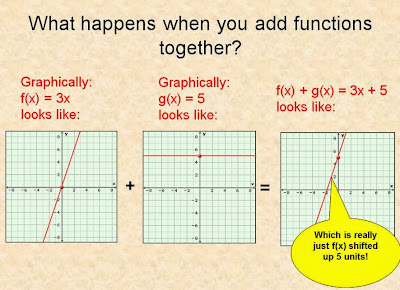

And replaced with this geogebra:....in which THEY will tell ME that the functions are being added. Notice the title of the file, gasmin of functions, gives nothing away - I used one of those 27 new trig function names instead of calling it "Adding functions". They're going to watch the coordinates of the red, blue, and green points as the vertical line moves around, and THEY'RE going to say "Oh, you're adding the y's." That simple concept, that the y's get added when functions get added, is something that almost all of my students-of-the-past have missed out on, due to the crappy way I've taught it.

Next they'll predict what sort of function the red dot is forming, after which they'll check by clicking on the checkbox called "Resulting curve". Then we'll talk about why the sum of two linear functions is also linear. Maybe we'll get into the algebra at this point, we'll see how it goes, but I'm really just looking for some number-intuition here. I hid the algebra view for a reason.

Bottom line, instead of me saying "We're going to add functions together and see what happens" this will be more like "What's happening here and why?"

Dialing up the explore:

Then I'll have them play around with the actual functions involved - what happens when you gasmin a linear with a quadratic, a quadratic with a quadratic etc.

Next, I've got a whole suite of geogebras with cryptic names to follow: tosna (subtraction), phyxyx (product), and drin (quotient). I'm sure they'll catch on and already know the next operation as we go, but at that point we can shift the focus onto the wonderful functions that you can form by doing simple operations to relatively normal run-of-the-mill functions. I'll let them play around with the functions and the operations for a bit, and I really want this to be fun for them, in the doing and in the sharing, so I'll have them share their creations to a gdoc so we can all see what sort of wonderful weirdness results. Who knows, with any luck, one of them will come up with a function we'll be studying later on this year, and we shall christen it with that kid's name. Find the domain and range of the function "Susie of x".

Dialing down the flip:

This means the original voicethread will lose about 21 slides. What's wrong with me that I thought that was a good idea?!?!?.

Most of what's left is about notation and algebra - specifically the algebraic way to do an operation on two functions, which is to do the operation on their algebraic rules. For example:

if f(x) = 2x + 3 and g(x) = x²
then (f +g)(x) = (2x + 3) + (x²)
= x² + 2x + 3 

Which brings me to the next improvement I need to figure out - how to get across this important idea:

(f + g)(x) = f(x) + g(x)

in other words, using the previous example

(f + g)(2) = 2² + 2(2) + 3, which comes to 11
and also f(2) + g(2) = 7 + 4, which also comes to 11

But I don't want to give them this kind of step-by-step, see-if-you-can-guess-the-point sort of way. I'd like it to be one of those cleverly orchestrated things in which they stumble onto it while they're doing something else....and I have to think of something before I give the voicethread to them to watch....not sure if I'll have time. Or an idea. But ideally, I want the voicethread to really be about pinning things down, but only if those things have already started to occupy their brains and annoy them.
This is me now.


I hope I can think of something before the day of, which is Tuesday.


Dialing up the apply:

I may give the activity from the text, which I used last year but which that group found really hard. It involves Reginald, who has investments in two companies, company A and company B. The number of shares he has in each company is given as the rules NA = 400 - 4t, NB = 1000 + 7t. There's a table to fill in, with the column headings time, NA, NB, and total number of shares.

Isn't this the most contrived, boring application ever?!?!

But at least it doesn't tell them to add, they intuitively do that, and it then invites them to find the totals both ways - first by adding the numbers in the columns, and then by using the algebraically simplified sum of the rules, to see that it comes to the same thing.

The next part uses the same story and sequence of activities to get them to multiply two functions, company A's shares (NA = 400 - 4t) by the value of those shares, which is given as v = 0.125t + 6.25. They fill in a table, get the values by multiplying the numbers in the table, then do it using algebra, and compare.

Perfect or Tuesday?

I don't know, this application just seems dumb. That's it, that's my professional assessment. But even if it's not perfect, do I need it to be perfect, or do I need it for Tuesday? I'm betting Tuesday will, once again, win out. At least there has been some improvement over last year, and I'm going to improve the one on composite functions the same way, in fact, I've already made the geogebra for that too.

As usual, please feel free to share your thoughts, good, bad, or ugly.

Thursday, September 19, 2013

Update #2 on Coteaching Project

Team vector's story so far:


Week 1:
Content:
  • the basic definition of a vector
  • the different representations (arrows, components, etc)
  • the various calculations involved, all of which were based on math that was really review, ie using sin and cos to find the components, using arctan to find the direction, and using pythagoras to find the magnitude.
  • In math only: relationships between vectors (identical, opposite, collinear, orthogonal)
Coteachingness:
  • We tried to coordinate and vary the activities in our classes, so that, of course, the kids wouldn't get bored, but more importantly so that they could see things in different depths and contexts - formally in math, and concretely in physics. For example, I showed them the polar coordinate system to help visualize vectors, particularly the way the angles are named, and Kerry and Andy had them performing various calculations involving velocity and force vectors, such as decomposing a vector. They probably paid more attention to things like units than I did. But I got to show the kids how to put their calculators in polar mode and graph pretty flowers and spirals!
  • To spread out the load, we took turns making the voicethreads - Kerry made the intro to vectors one, and I made the representations one etc.
  • We wanted to make the team aspect of this very visible, so we commented on all of the voicethreads, whether or not we were the author. That's another reason voicethread is a great tool for this kind of collaboration.
Week 2:
Content:
  • operations on vectors - addition, subtraction, and multiplication by a scalar.
  • all of these operations done in all of the various representations
Coteachingness:
  • We started using a googledocs version of our joint schedule (see previous post) so we could keep each other updated.
  • We tried to step it up a bit with the visible teamwork. Kerry and I had envisioned a video with all of us in it, because it would be fun for everyone, kids and teachers. We wanted to introduce vector addition with the three of us having a real tug of war, but of course time and distance got the better of us, so here's what we ended up with:


  • As you can see by their comments, the kids really enjoyed this one! Just imagine if we were able to really get together and act out stuff like this - I bet the retention rate would be off the scale!
  • We, the teachers, tried to meet to give feedback, but we were only able to manage 2 people at a time. All agreed that this has been great fun, and we'll try it again, if not later this year, next year for sure.
Week 3:
Content:
  • Here's where our paths diverged, because this was as far as the Physics course went in terms of content. But now they would start applying their skills big time to solve vectors problems.
  • In math, dot product (two different methods)
  • Chasles' property
  • Linear combinations
  • Applications
Coteachingness:
  • We're still in the same neighbourhood, but we didn't really coteach much this week.
Thoughts for next time:

I hope this isn't the end of coteaching this year, but we have to find a logical place to try it again. It may be that I'll move to chemistry - logs and exponentials maybe? Fortunately, Kerry is also the teacher for that course! Things to work on:
  • We need to meet much more often, before, during, and after. More planning, coordinating, cross-feedback, followup - more goodness!
  • Team videos are so happening. But we are so rarely in the same physical space that we need to know what we're doing before we meet again - which will probably be Christmas, or maybe even June.
  • We need to find more ways to cross-pollinate. How can we use this strategy to get to the really deep, unexpected, authentic, real-life important learning?
Thanks for reading, any ideas or questions are hysterically welcome!

Friday, September 6, 2013

Update #1 on Physics-Math Co-teaching Project

First of all, start your weekend right, and watch this:

Don't you love that? Nothing to do with this post except that it's how I started each class today. Some of our kids are sitting in front of the computer all morning and I figured they, and everybody, could benefit from getting up, dancing and laughing for a few minutes!

The Project:

Okay here's what's happening in our first-ever co-teaching project. We had really only 3 days this week, because Monday was a holiday, and Physics doesn't happen on Friday for our kids.

Here's how we're keeping track of which kid is in whose class and when, and what they're doing there. Of course I removed the actual names of our students, but on our actual schedules, their names are highlighted as you see here:


3 class schedule with st names from amcsquared

For example, the yellow kids I teach period one are also in Kerry's period 3 Physics class. Andy has the blue kids in his period one class, then I see them period 3 etc. The black X, Y, Z, W, R, and S are kids who are only in those classes.

As you can imagine, we have to make sure that:
  • Each child has access to the same content and materials, whether or not they're taking both math and physics.
  • The kids who are taking both don't hear the same thing twice a day.
  • If sequence is an issue, the kids who are taking both see things in the same sequence
  • We don't overload them with double the work - they don't need to do the same type of practice examples for both classes
That's why we have to:
  • deliver content outside of class
  • keep our class activities as stand-alone as possible
  • keep talking to each other
Here's this first week's schedule with my stuff filled in:


Tuesday was our first day, so we all did the usual first day stuff, getting to know you, using the tools, etc. Friday was used to cover some topics that were only part of the math program, since there's no physics class that day. I also took the opportunity to introduce them to geogebra, a tool that I hope the kids will use later this year to create a joint math-science manipulative.

Student feedback:

Only informal so far. The kids seem to be happy with the co-teaching. They've said that they really appreciate the common "homework" - so far that's the only advantage they have seen. One of my blue students arrived to class and said that he had had a question to ask me, but that during his Physics, it had been answered. Cool. I'm looking forward to when they see a deeper advantage - learning in context, or more deeply than they would normally do. That'll take a lot more meetings and experience on our parts, and of course the beginning of the year is probably the WORST time for that!

My feedback:

It has been great bouncing ideas off of each other. We just jumped in and got our feet wet, and I already feel like I'm doing a better job of teaching. For example, having to make the activities stand-alone and non-repetitive forced me to to come up with polar coordinates as another way to view vectors. I never did that before. And the kids REALLY responded to the spirals on their calculators, not to mention they were surprised that the calculators they have had for all these years could be put into polar mode.

The plan next week:

Next week, we're going to do operations on vectors, with lots of in-class practice and investigation. We had dreamed of doing a joint video, with the three of us pretending to do a tug of war....but my daughter is turning 18 this weekend so.....I don't think that video is gonna happen, time for some Camtasia magic animation techniques!

It's a start! In the meantime, Hatee-hatee-hatee-ho! (if you don't know what I mean, go back and watch The Fox. And geez, DANCE, will ya?)

Monday, September 2, 2013

Collaborative Teaching Project #1

This year, the Math and Physics online teachers at LearnQuebec are going to try co-teaching! I and two colleagues - Kerry Cule and Andy Ross, who both teach Physics, have decided to collaborate on the first unit, which is vectors. The content is pretty much the same in both of our courses, so we figured what the heck. At the very least, we'll be more efficient, and at best, we'll be able to provide richer experiences for our students.

One of the challenges is that we can never be in each other's classes, because our schedules conflict. Oh yes, and one of us lives in Montreal, one in Ottawa, and the other in New Brunswick. Another challenge is that not all of our students are in both Math and Physics. Most are, but we of course don't want those students who aren't to be at a disadvantage, so we decided to try it as follows:

Week 1: We split up the topics, and we've each created one recorded lesson, which all groups will watch asynchronously. Then, during our classes we'll do activities that put the concepts in the framework for our own subjects. 

Week 2: Similar, but we're thinking of doing videos in which we all appear, just to make things more fun. one idea is to have the teachers doing a tug of war, to illustrate vector addition. That'll also be challenging considering we don't live anywhere near each other - I think Camtasia will have to provide some magic for us there.

We'll see how it goes. So far, the most challenging thing has been finding a way to represent the joint schedules so that each teacher can immediately know which of the their students is in which other class, if any. I've made a colour-coded one that makes use of every possible colour Word's got.

At some point, I'm hoping we'll collaborate, at get our kids to collaborate also, in the spirit of my One Big Idea that I wrote about toward the end of last year.

Here goes nothing! 

Wednesday, July 10, 2013

The Rockstar-Free Canflip13 Conference

I finally have time to write about the CanFlip13 Conference, in Kelowna BC, organized by the brilliant team of Graham Johnson and Carolyn Durley, at which I and my colleague Peggy Drolet were presenting. I'll be posting in more detail about the sessions, including my own, but to summarize, it was a conference unlike any I've ever been to - and I knew it would be, from way before we even arrived. I don't mean to disparage any conferences, only that the bar was not only set higher, but it was another kind of bar altogether. Carolyn and Graham really know how to:
  1. Make people feel welcome
  2. Put together a terrific conference
  3. Build a community
  4. Teach like there's no mañana
  5. Create a rockstar-free zone
But to start with, here's what happened, in chronological order:

Wednesday June 19:

Arrived in Kelowna with my arm in a sling, from terrible shoulder pain, loaded up (in many ways) with painkillers. Reached my daily allowance for painkillers early in the day because of time change. Peggy and I cabbed it to the hotel, in torrential rain.

The El Dorado Hotel was lovely, and we settled into our room. I unfortunately had to correct some exams before doing anything else. Technology makes it impossible to get away from work, doesn't it? Peggy passed the time by face-chatting with her hubby on her new iphone, which she loves as much as said hubby. (Gee, didn't see that one coming, eh?) Once I was done, we got ready for supper, which was being hosted by Carolyn and Graham at the hotel. Who does that? How nice are these people? I decided to leave the sling behind, for I was NOT ruining my ensemble, nor meeting these people by looking pathetic, no matter how much it hurt.

When twitter friends finally meet!
We got down to the dining room, found our table-for-twenty, and noticed (!) that we were the first ones there. Oh well, guess what, it's beer time in Kelowna! The draught we tried was made in Kelowna, and was fantastic! Funny, my shoulder wasn't hurting at all....

Carolyn and Graham arrived! Carolyn burst into tears when she saw us. That made me do the same. These are simply the nicest people in Canada. I mean, just hosting a dinner for out-of-towners right out the gate was so welcoming! I have been tweeting with both of these people for over a year, but meeting f2f was indescribably joyful.

The other out-of-towners arrived, including another dear twitter friend, Karl Lindgren-Streicher, whom I thought I was also meeting f2f for the first time....I was embarrassed to learn, from Karl, that we had actually met last year in Chicago at Flipcon12, but all this year, as we had been tweet chatting, I hadn't realized it was the same guy. Sorry, Karl, I kept telling people about this great history teacher I had met, I just didn't connect the dots that it was you! Anyway, he is living proof that some people are exactly the same in person as they are online. He is exactly as nice and smart and thoughtful and down-to-earth as you think he is, probably even more. Karl, if you're reading this, I adore you. And your ladyfriend Emily too.

Also met Troy Stein, Ali DeGuia, Lily (don't remember your last name Lily sorry, but we are soul sisters!) and lots of lovely people. A truly great evening, and my shoulder didn't bother me all night. Hmmm....interesting.

Thursday June 20:

We read about the floods in Calgary with horror. As we cabbed to the school, again in torrential rain, we wondered if this was the same system that caused the flooding. Everyone here kept telling us that this kind of weather was atypical of Kelowna, in fact, they usually have not enough rain. Disappointing, plus, I had to put the sling back on. Too early for beer.

The conference's main gathering place was the gym, at the front of which was a screen displaying live #canflip13 tweets, which is why......
That's Dianne in the heart. (I added the heart.)

Our own boss's image greeted us as we walked in! (Those are huskies painted on the wall behind the screen) >>>>>>

Keynote #1:
Carolyn and Graham then kicked off the conference with their wonderful keynote, which was the story of their journey together, as teachers looking for more ways to connect, engage students, collaborate and learn. For them, it seems that it really turned a corner when they attended Flipcon11. Carolyn addressed the ongoing debate about flipping by pointing out the double-edged sword of labels. As usual, she chose words that honoured both sides of the debate, while making it clear that we're all after the same thing - what's best for our kids. What I liked most about this keynote was that it mirrored its own content. They spoke together about how they learn and grow together.

Session #1:
Despite wearing a sling, I high-tailed it to the first session I wanted to attend, which was Ramsey Musallam's Inquiry Based Learning. Made it just before SRO status was reached. I am doing a separate post on that session, because too much happened that did too much disruption to too much of me. Suffice it to say that within minutes, and without saying very much, he had the room buzzing, in every possible way. One memorable moment: Karl came over to my table and said  "Look at the body language in this room." Sure enough, every single person was bent over their tables, talking to someone, solving something, totally unself-consciously involved in the task.

Next was lunch, but I have to say I didn't pay much attention to it, because I was getting ready for my own session, on Geogebra. I had tried to truly flip it, by making several short how-to videos available for people to watch ahead of time, so that we could potentially go deeper during our f2f time. But I had the sneaking suspicion that most would arrive not having watched, which was fine, I know what June is like for teachers. But that meant I was walking into a potentially highly mixed group, some ready, some not. I had thought that I would handle that the same way I do in my class, but today, it suddenly seemed like a bad idea. It's one thing with your own students, but it is another thing entirely with grownups. I sensed impending disaster. Nevertheless, Peggy and I headed off to my assigned room.

Session #2: My session: Yes, it's all about me

Ten minutes before I was to start, I discovered that Open Office had messed up the formatting on several of my slides, so I spent those last few minutes NOT taking deep cleansing breaths, NOT rehearsing, and NOT greeting people as they arrived, but instead frantically fixing the slides:
How stressed am I?
My hair was straight ten minutes ago.
(Okay no it wasn't.)
(Still.)
At go time, I looked up and saw that only 7 people were there anyway. But one of them was Ramsey Musallam - he counts for like 20 people, no? For whatever reason, I totally forgot about my shoulder.

I had planned to talk for a few minutes, then have everyone doing something (watching a vid, doing the accompanying practice, creating etc)  for 20 minutes - 20 noisy, choice-filled, fun, Ramsey Musallam session-ish minutes, then have a post-discussion/question period, then say a few more conclusion/what's-next things. But all of this banked on the presupposition that one of me would not be enough to go around the room, for there would be 20-30 people there. Well, with only 7 people, there was more than enough of me to go around, so after I said my intro, and everyone was "doing something",
it was eerily and uncomfortably quiet. I did the classic wandering-teacher-walk, where your eyes are begging someone, anyone, to ask you a question. It did happen, a bit, I guess, but I definitely could have filled that time some other way. As I said, I'll be writing more about this.

I hadn't known what to expect, had banked on a certain outcome, and in my opinion, backed the wrong horse. The participants were very kind, in particular Ramsey, and Lori Jones, who each gave me a twitter shout-out.

Next time, which will be in Ohio, will be different. More about that later.


Session #3:
Peggy's session was next, so off we went to her assigned room. She was also disappointed in her session's attendance, but she nevertheless gave an amazing presentation on using Voicethread. I was and am so proud to call this lady my colleague. She and I have always agreed that for anyone starting out flipping, who is also feeling overwhelmed by making videos,Voicethread is the perfect tool.
Peggy being amazing
One person who attended her session was absolutely convinced of that at about ten minutes in, and in fact, we found out later, he enthusiastically told everyone else from his school about it, then discovered that his school already had a Voicethread account!

After day one was over, and the stress of presenting was relieved, it was time to get hammered get together for a little aperitif. We met a whole bunch of Canflip people at Cabana's and resumed our relationship with Kelowna beer. There was food, laughs, and great convos all around, and to top it all off, Troy Stein very kindly picked up everyone's bill! We decided to stay at this place for supper, so we joined up with another table of canflip people that included Tara Cordy-Simpson, Valerie Pereira, and Andy Miller. Another great meal, more people to call friends, and no shoulder pain.

Friday June 21:

Keynote #2:
The final day began with Ramsey Musallam's keynote. Imagine tweeting an entire speech. I think the attendees collectively managed to do that. Things that I still remember: Ramsey's and Jon Bergmann's 1st videos, intentionally withholding info instead of finding best way to present it, using this video to hook us, Steve Jobs' speech, best movie ever made - The Karate Kid, "I skate to where the puck is going to be, not where it has been", my personal favourite:
I have no idea how to balance a chemical equation but I loved watching you blow s**t up
Session #4:
My first session today was Philip Jones' Gaming. This man showed us the astounding amount of work that he has done creating this game-based learning site for his students. He even gave us access to try it out, which I haven't done yet, but will.

The lady next to whom we happened to sit was Jana Kreway, who as it turned out, had enough personality for about 15 really happy people. She is a mom whose kids are now old enough that she is beginning her second career -  teaching math. One of her kids had had Graham Johnson for a math teacher, and Jana was inspired by him (who isn't?) but was feeling a bit overwhelmed on this particular day by the technology. Hmmm....if only there was some advice we could give her......!


So naturally, Peggy shared with Jana her Voicethread presentation, and this is what Jana looked like as she watched it:
Enough said. Jana also told us that she was new to twitter, but we noticed she tweeted this soon afterward:
Session #5:
My last session was Troy Stein's Advanced Camtasia tips. Troy showed us, among other things:
  • audio points
  • what's in the clipbin vs what's in the library
  • adding to your own library
  • leading with 5 secs of silence to remove noise later
  • making a template lead-in to use on all vids, to lend consistency
  • GREEN SCREEN!
  • using green screen to make my own bank of handwritten callouts
But Troy isn't just about the tech. He's a kind, sensitive, generous person first and foremost. I tweeted many things that he said, like this:
I also learned a lot about tact from this man. One participant was pursuing a line of questions that were not of general interest to the room, and I admired how Troy handled it, which I tweeted:
As soon as I tweeted that, I received a DM from none other than @approx_normal, also known as Captain Bad Idea, aka Hedge, a math teacher whom I have admired for a long time for her humour, kindness, and bravery. But have never, like, spoken to. Turns out she and Troy are good friends! She told me about what a great guy he is, and she asked me to tell him that "his sis Hedge says hi", which I did after his session was over. After chatting with Troy about Hedge, my next tweet had to be this:
Final gym session:
Finally, Carolyn and Graham lead us in an activity called "What sucks". I am so using this with my classes at the beginning of the year. I'll have to adapt it to the virtual room, but here it is:
  • Everyone stands up.
  • One side of the room is designated as the "This sucks" side, the other "This doesn't suck" side.
  • Something is displayed on the screen at the front for all to see, for example, "Teachers on social media with their students." 
  • Everyone has to then move to whichever side of the room most accurately expresses their attitude towards it. Oh and you can stay in the middle if that's how you feel. Which is where I spent most of my time, because after all, I am a middle child, and I see everyone's point of view.
  • Once there, share with a neighbour why you're there.
  • A volunteer from each of the three sections speaks to the whole gym about why they are standing where they're standing on the current issue.
It was fun, it got us moving, thinking, talking, laughing, and even changing our minds. I think it'd be interesting to get people to submit their own topics for the vote, after warming up a bit.

All in all, getting back to my 5 points at the beginning:
  1. The welcome: presenters not having to pay the registration fee, the introduction-to-me videos we all posted pre-conference, receiving an allowance for expenses, the lovely welcome dinner before it all began, and mostly just Graham and Carolyn's personalities.
  2. The terrific conference:
    • The atmosphere was relaxed, which is partly the personalities involved, partly the size of the event, and partly the venue - a school and its gym, with which we're all familiar.
    • A part of me thinks that it was because it happened in Canada, but don't get mad, I'm a dual citizen, US and Canuck. It makes a difference when you're in your own country.
    • The whole thing felt like a celebration at times. That we could finally meet friends, but also that this was a place where it was safe to say the word flip.
    • It was really hard to pick a session, because it was really hard to miss any of them. 
  3. Build a community: Wifi was great, so tweeting was rampant, and always displayed in the gym.  Twitter is the starting point for community. Plus the icebreaker activity on day 1 and the final "What sucks"activity
  4. No mañana: I don't think either Graham or Carolyn stopped presenting the entire time. Or teaching - there were still students in the building hovering around them, who obviously worshipped them.
  5. Rockstar-free zone: There were people there who are what some would call rockstars, people whose ideas and work have had a major impact on many people. But there was no one who would call themselves that. Everyone acted, and was treated, like a normal person, and no task was deemed too low. I mean, just to drop two names here, Carolyn helped me get my laptop onto the wifi, and Graham helped me get my room setup.
Just a couple of other random observations:
  • Reading about someone's work is one thing, seeing them in action is everything. As Andy Miller put it:
  • Alcohol and adrenaline are great painkillers. There I said it.
  • I do get tired of hearing about new tools, but I will never get tired of meeting new people, with or without a new tool!
Thanks Carolyn and Graham, for giving yourselves so completely to your work, your students, your communities, and the teaching profession.  Ã€ la prochaine!

Carolyn, Karl, Graham, Me, Valerie, Tara, Peggy, & Andy

Thursday, June 27, 2013

Thoughts on the MTBoS - from a Relative Newbie

I think I've been composing parts of this post for a while. It finally came in for a landing this week. Let me say at the outset that I have the utmost respect for the people of the Global Math Meeting!

A couple of nights ago, at the weekly Global Math Meeting, there was a discussion about the Math Twitter Blogosphere (MTBoS), which seems to have set off a kind of virtual earthquake - tweets, posts, and probably emails have been rippling through the lines ever since - for some examples, read here, here, here, and here. The discussion at the meeting was supposed to be centered around how the MTBoS can grow, and be more welcoming for newbies. That discussion, and the resulting ones, really shook me up and to explain why, I have to go back to.....

My first GMM meeting:

I started attending this amazing weekly online gathering of math teachers near the end of 2012, when I was invited, by the superhero-like Megan Golding, to give a ten minute presentation about how I flip my math class. There were other presenters, which is why it was only a ten-minuter. I have to say that when I entered the virtual room, I was immediately intimidated, for many reasons. But the online environment was not one of those reasons, because I teach in exactly that kind of space, so I'm used to it. What got me was how many people showed up for the talk, plus WHO they were, I mean, there were some NAMES. People whose blogs I've been reading, and probably you've been reading forever, really, really brilliant, famous, brilliant people.  I should have been tipped off when I saw that it was Kate Nowak who gave Megan my name.....

Anyway, Megan, being the great moderator that she is, advised the presenters to ignore the chat window because it would be distracting, and that she would monitor it for questions etc, which I really appreciated. As an online teacher, I know how hard it can be to maintain focus, keep the flow AND keep your eye on the chat window. It's similar to when a brick-and-mortar classroom teacher reads the room - you want to be able to say what you want to say while you scan faces for reactions, but in the online environment, where there's no eye contact or body language to go on, it means having to split your brain into two halves - the one that's presenting and the one that's reading. So I prepared myself to forget about who was there, let Megan have my back, and to ignore the chat.

Bring it on.

That lasted about 2 seconds, because what showed up in this chat window was unlike anything I'd ever experienced in my class. I wasn't prepared for the banter. A lot of joking and cajoling went on between the audience members, and it was immediately clear that these people were long-time friends, had a high level of comfort with each other, were even smarter than I had imagined, and were here for socializing as much as they were for math stuff. Unnerving for a GMM newbie, but fascinating nevertheless.

But I have to say, this made me feel like nobody was actually listening to me. I'm sure it wasn't the case, and nobody intended to do that, but there it is. Some of the presenters seemed able to jump right in with their own portable comfort zone, but I don't have one of those. And me being me, I blamed myself - after all, if I were interesting enough, there wouldn't be any banter, would there?

You'd think I would never go back, right? Wrong. I put on my big-girl pants and kept going. (Megan alone was enough of a draw for me, for she is the nicest person in North America.)

I haven't missed more than 2 or 3 GMM's since then. My shaky experience as a presenter was way overpowered by the brilliance of the ideas I heard week after week - interactive notebooks, gaming, lesson bonfire - to name a few. Not to mention that these people could probably all be stand-up comedian/comediennes, and mostly not to mention that I have become friends with some really wonderful people there. The GMM seems like a group of friends who happen to be math teachers taking turns sharing their ideas and making each other laugh. I look forward to each one, even though I'm still pretty much lurking. Although this post would be the definition of not lurking.....

The Antichoir

At any rate, I was just getting comfortable when earlier this week I saw tweets from a few members about flipping, which had been my topic way back in December. Tweets that I felt were unkind, and not representative of the open-mindedness and sensitivity that teachers strive to model for their students. The thread eventually circled back to become fairer, but I thought back to that first meeting - is that why there had been all the banter? I had been preaching not to the choir, but the antichoir?

Then came the meeting about MTBoS, which was called Choose Your Lunch Table. The title reminded me of a particularly clique-y staff to which I used to belong, but I could not have been happier to read the intro:
The #MTBoS can be an intimidating place for newcomers. Many seasoned veterans of the MathTwitterBlogoSphere have developed friendships and professional working relationships over the course of its lifespan. How can newcomers become an integral part of this community and feel at home? Let's drive the #MTBoS forward!
Those words alone were the reassurance I needed that the GMM was NOT the antichoir, and not even a clique, but a group of people engaged in a genuine attempt at group self-assessment.

But during the GMM, the discussion wove in and out of things like - Why are we trying to grow, it's not about the numbers, how can we decide for others who aren't here, people have different expectations, some people feel intimidated to blog, some get more attention than others, etc etc.  It was a great discussion, but it continued on into subsequent posts and counterposts, of which this is one. Many feelings emerged that surprised me - I wasn't the only one who felt intimidated, for example. I guess hurt feelings happen all the time, to everyone, unintentionally and even unwittingly.

I realized that just like our students, we all need the relationship to come first, and the learning second.

My thoughts, FINALLY geez:
  • On welcoming: Before welcoming new people, make sure the ones that are already there feel it. I do now, but it took some time. And pants.
  • On blogging: Sure, we all have to be tough in the TwitterBlogoSphere. It's a daily chant for me: Blog for yourself and don't expect a million retweets or comments, because it's not about that. It's about reflecting on your practice, improving, and documenting your journey. I do it in public just on the off chance that someone else will be interested, but that's not the goal. I have to accept the fact that when I put myself out there in front of the world, I might be ignored by the world. It's okay, I'll still learn something.The flip side is that if and when I do get attention, it's the ultimate, most authentic tip of the hat. No one wants to change that, because no one wants a charity comment, or a pity tweet.
  • On communicating: The thing is, in the TwitterBlogoSphere, just like in the virtual classroom in which I teach everyday, all those tweets, posts, comments, in other words, WORDS, take the place of body language and eye contact.  The more evidence there is in those words that they come from a caring soul, who's more interested in being kind than in being right, the better and more long-lasting the impact. And there is no doubt in my mind that the MTBoS is a community of such people.
  • And they're also hilarious.

Sunday, June 9, 2013

Life, Twitter, and General Weirdness

Twitter, like life, is just too weird and wonderful to explain. However, here's my attempt:

Last Friday, after finishing my classes for this school year, I was absolutely fried, with achy shoulders, neck, and throbbing mouse-wrist, all the result of having been on my computer non-stop for one practically sleep-free week. I was about to close up shop and head out to my garden for some quiet, green, life-affirming tech-free time, but first tweeted something, I have to admit, without much thought. Just kind of putting a punctuation mark to the week, on-my-way-out-the-door type of thing.

Here's the tweet, and as of today, here's what's happened with it:

26 retweets and 9 favourites. That might not seem like a lot to some of you, but it's huge to me, not to mention life-affirming. Not just because I went from feeling pretty dead to pretty happy, not just because of the amazing conversations and ideas I've had since then, and not just because I got to add all kinds of great people to my PLN, but also because it illustrates the nature of twitter that's so hard to explain to people who aren't on twitter.

If a living organism were a conversation, it would look like twitter. Utterly unpredictable, instinctive, multi-faceted, energy-consuming AND generating, changing direction instantaneously, constantly mixing and remixing, growing or dying depending on infinitely many factors....but ultimately striving to become better and stronger, on the way to becoming part of a much bigger, richer tapestry. Except on twitter, instead of genes being exchanged, it's ideas.

And why would anyone choose NOT to participate in that? You can either stay alone on your own little rock, surviving on what's always worked in the past, or you can jump into the idea pool and thrive. Everybody wins, and everybody's got something to share, but the thing is, you may be the last person to know it until you go for it.

And that 140 character thing that seems so limiting? Yeah, well, genes only get to use 4 (ATGC), and look where that got us!