Thursday, June 27, 2013

Thoughts on the MTBoS - from a Relative Newbie

I think I've been composing parts of this post for a while. It finally came in for a landing this week. Let me say at the outset that I have the utmost respect for the people of the Global Math Meeting!

A couple of nights ago, at the weekly Global Math Meeting, there was a discussion about the Math Twitter Blogosphere (MTBoS), which seems to have set off a kind of virtual earthquake - tweets, posts, and probably emails have been rippling through the lines ever since - for some examples, read here, here, here, and here. The discussion at the meeting was supposed to be centered around how the MTBoS can grow, and be more welcoming for newbies. That discussion, and the resulting ones, really shook me up and to explain why, I have to go back to.....

My first GMM meeting:

I started attending this amazing weekly online gathering of math teachers near the end of 2012, when I was invited, by the superhero-like Megan Golding, to give a ten minute presentation about how I flip my math class. There were other presenters, which is why it was only a ten-minuter. I have to say that when I entered the virtual room, I was immediately intimidated, for many reasons. But the online environment was not one of those reasons, because I teach in exactly that kind of space, so I'm used to it. What got me was how many people showed up for the talk, plus WHO they were, I mean, there were some NAMES. People whose blogs I've been reading, and probably you've been reading forever, really, really brilliant, famous, brilliant people.  I should have been tipped off when I saw that it was Kate Nowak who gave Megan my name.....

Anyway, Megan, being the great moderator that she is, advised the presenters to ignore the chat window because it would be distracting, and that she would monitor it for questions etc, which I really appreciated. As an online teacher, I know how hard it can be to maintain focus, keep the flow AND keep your eye on the chat window. It's similar to when a brick-and-mortar classroom teacher reads the room - you want to be able to say what you want to say while you scan faces for reactions, but in the online environment, where there's no eye contact or body language to go on, it means having to split your brain into two halves - the one that's presenting and the one that's reading. So I prepared myself to forget about who was there, let Megan have my back, and to ignore the chat.

Bring it on.

That lasted about 2 seconds, because what showed up in this chat window was unlike anything I'd ever experienced in my class. I wasn't prepared for the banter. A lot of joking and cajoling went on between the audience members, and it was immediately clear that these people were long-time friends, had a high level of comfort with each other, were even smarter than I had imagined, and were here for socializing as much as they were for math stuff. Unnerving for a GMM newbie, but fascinating nevertheless.

But I have to say, this made me feel like nobody was actually listening to me. I'm sure it wasn't the case, and nobody intended to do that, but there it is. Some of the presenters seemed able to jump right in with their own portable comfort zone, but I don't have one of those. And me being me, I blamed myself - after all, if I were interesting enough, there wouldn't be any banter, would there?

You'd think I would never go back, right? Wrong. I put on my big-girl pants and kept going. (Megan alone was enough of a draw for me, for she is the nicest person in North America.)

I haven't missed more than 2 or 3 GMM's since then. My shaky experience as a presenter was way overpowered by the brilliance of the ideas I heard week after week - interactive notebooks, gaming, lesson bonfire - to name a few. Not to mention that these people could probably all be stand-up comedian/comediennes, and mostly not to mention that I have become friends with some really wonderful people there. The GMM seems like a group of friends who happen to be math teachers taking turns sharing their ideas and making each other laugh. I look forward to each one, even though I'm still pretty much lurking. Although this post would be the definition of not lurking.....

The Antichoir

At any rate, I was just getting comfortable when earlier this week I saw tweets from a few members about flipping, which had been my topic way back in December. Tweets that I felt were unkind, and not representative of the open-mindedness and sensitivity that teachers strive to model for their students. The thread eventually circled back to become fairer, but I thought back to that first meeting - is that why there had been all the banter? I had been preaching not to the choir, but the antichoir?

Then came the meeting about MTBoS, which was called Choose Your Lunch Table. The title reminded me of a particularly clique-y staff to which I used to belong, but I could not have been happier to read the intro:
The #MTBoS can be an intimidating place for newcomers. Many seasoned veterans of the MathTwitterBlogoSphere have developed friendships and professional working relationships over the course of its lifespan. How can newcomers become an integral part of this community and feel at home? Let's drive the #MTBoS forward!
Those words alone were the reassurance I needed that the GMM was NOT the antichoir, and not even a clique, but a group of people engaged in a genuine attempt at group self-assessment.

But during the GMM, the discussion wove in and out of things like - Why are we trying to grow, it's not about the numbers, how can we decide for others who aren't here, people have different expectations, some people feel intimidated to blog, some get more attention than others, etc etc.  It was a great discussion, but it continued on into subsequent posts and counterposts, of which this is one. Many feelings emerged that surprised me - I wasn't the only one who felt intimidated, for example. I guess hurt feelings happen all the time, to everyone, unintentionally and even unwittingly.

I realized that just like our students, we all need the relationship to come first, and the learning second.

My thoughts, FINALLY geez:
  • On welcoming: Before welcoming new people, make sure the ones that are already there feel it. I do now, but it took some time. And pants.
  • On blogging: Sure, we all have to be tough in the TwitterBlogoSphere. It's a daily chant for me: Blog for yourself and don't expect a million retweets or comments, because it's not about that. It's about reflecting on your practice, improving, and documenting your journey. I do it in public just on the off chance that someone else will be interested, but that's not the goal. I have to accept the fact that when I put myself out there in front of the world, I might be ignored by the world. It's okay, I'll still learn something.The flip side is that if and when I do get attention, it's the ultimate, most authentic tip of the hat. No one wants to change that, because no one wants a charity comment, or a pity tweet.
  • On communicating: The thing is, in the TwitterBlogoSphere, just like in the virtual classroom in which I teach everyday, all those tweets, posts, comments, in other words, WORDS, take the place of body language and eye contact.  The more evidence there is in those words that they come from a caring soul, who's more interested in being kind than in being right, the better and more long-lasting the impact. And there is no doubt in my mind that the MTBoS is a community of such people.
  • And they're also hilarious.

Sunday, June 9, 2013

Life, Twitter, and General Weirdness

Twitter, like life, is just too weird and wonderful to explain. However, here's my attempt:

Last Friday, after finishing my classes for this school year, I was absolutely fried, with achy shoulders, neck, and throbbing mouse-wrist, all the result of having been on my computer non-stop for one practically sleep-free week. I was about to close up shop and head out to my garden for some quiet, green, life-affirming tech-free time, but first tweeted something, I have to admit, without much thought. Just kind of putting a punctuation mark to the week, on-my-way-out-the-door type of thing.

Here's the tweet, and as of today, here's what's happened with it:

26 retweets and 9 favourites. That might not seem like a lot to some of you, but it's huge to me, not to mention life-affirming. Not just because I went from feeling pretty dead to pretty happy, not just because of the amazing conversations and ideas I've had since then, and not just because I got to add all kinds of great people to my PLN, but also because it illustrates the nature of twitter that's so hard to explain to people who aren't on twitter.

If a living organism were a conversation, it would look like twitter. Utterly unpredictable, instinctive, multi-faceted, energy-consuming AND generating, changing direction instantaneously, constantly mixing and remixing, growing or dying depending on infinitely many factors....but ultimately striving to become better and stronger, on the way to becoming part of a much bigger, richer tapestry. Except on twitter, instead of genes being exchanged, it's ideas.

And why would anyone choose NOT to participate in that? You can either stay alone on your own little rock, surviving on what's always worked in the past, or you can jump into the idea pool and thrive. Everybody wins, and everybody's got something to share, but the thing is, you may be the last person to know it until you go for it.

And that 140 character thing that seems so limiting? Yeah, well, genes only get to use 4 (ATGC), and look where that got us!

Monday, June 3, 2013

How One Student Stopped Me From Dropping the Ball

Every year, June review time is when I drop the ball. I usually give out all kinds of review packages and old exams, together with answer keys, and say to my students "Here you go, my part's done, now it's up to you - good luck!" I also drone on and on during the last few classes about all the bazillions of things we did all year, during which time I literally put myself to sleep. I do this because my brain swirls with these kinds of thoughts: "Well I can't possibly go over everything anyway...If they don't know it now they never will....They need to do the work now not me....and anyway this is SO BORING!"  Basically, I drop the ball on the field and say, here it is, if you want it, come get it.

But that's not the same thing as passing the ball, so that someone else benefits from your momentum. This year, I tried to pass the ball. What made that happen? One student's words.

A couple of weeks ago, I asked my students for some input on how they wanted to review for their June exams. They gave me their ideas via a google form. Here are a few:
The best way for me to review is to gather all my notes and start rewriting down the rules to remember them but mostly...practice , practice , practice!
Review packages, those are the best thing for me to review a whole year's worth of stuff. 
My ideal review would be to actually review everything we did since the beginning of the year and not only do practice..... I think we would just need to refresh everything in our minds. 
do some problems from every chapter but i know you know how to do the best review ever :) 
That last one is the one that did it. "I know you know how to do the best review ever." That came from a student who has put in an effort of 200% all year, and more importantly, has always taken the time to tell me how much he appreciates my efforts, so he had my ear. When I read that, all those swirling, bored, tired, I'm-now-dropping-the-ball thoughts thudded to the floor. I did NOT want to let this student, or any of my students, down.

So I put together some overviews that actually did make it interesting, at least for me, who has seen it all before a zillion times. Based on their reactions, it didn't work perfectly, and I already see lots of places to improve. But I feel better about this than anything I've ever done at this time of year in my entire career.

First, I must mention, that all year we've used a graphic organizer for each of the functions we've studied. I call it the Wheel of Function (get it? Wheel of Fortune?....sigh....). Every time we finish a new function, we go around the wheel of function and summarize it using these headings, so this is not the first time I've tried to give them a Big Picture of some sort:


But this time, it became the Wheel of FunctionS:


I used the wheel to make activities that would:
  • cover a heck of a lot of material in a very short time
  • meet them halfway in terms of content - start with activities at the lower end of Bloom, then work our way up
  • get them up to speed so they can do the practice they need/want
  • deepen understanding for some
  • cause understanding for others
  • at the very least make them do some review during class if nowhere else
Here are some that we did, and some that I came up with afterwards, with the instructions I gave as captions. By the way, these were all given to them in powerpoint format, so that they could move the tiles around:

Graphs: Start with simple recall:

Match the groups of graphs to the function rule


Then get into more detail:
Move each tile into the appropriate column


Properties:
After more matching, look at the properties from a comparative point of view, leading to some Higher-Order-Thinking: There are similarities between log and square root function domains, so why is the only difference the inclusive/exclusive brackets? Or - The exponential and log graphs look very similar - how can you tell the difference between them?


Definitions of basic functions:

For this one I had them all writing on the board, just for variety. It was interesting to see how little everyone remembered. And frightening. It was a great opportunity to go over the algebra behind how we simplified them, and there was an aha moment for at least one student who said she hadn't noticed that we never did simplify the trig functions. Next year, maybe we will by using identities (AT LAST SOMETHING USEFUL HAS COME FROM IDENTITIES!!!)

Fill in the simplified form for each function

Solving equations and finding intercepts:

Before getting into the nitty-gritty algebra, an overview of What to Expect When You're Solving an Equation. (I think next time, I'll have them fill in the orange part first.) The idea behind the purple part was that for some equations, it's obvious when there's no solution - for example, if a quadratic equation has no solution, some kids find out only when they try to take the square root of a negative number, and their calculator lets them know. But for some equations, it's easy to miss when there is no solution, because the algebra doesn't always alert you, for example, in this equation,        it's very tempting to square both sides, but the fact is that there is no solution to it. I wanted them to be on the alert for those situations, as well as to realize, perhaps for the first time in their math lives, that linear equations ALWAYS have a solution, as do logarithmic ones:

1. Fill in the number of intercepts that the given function can have: none, 1, 2, or infinitely many.
2. Indicate whether it's obvious when the given type of equation has no solution, and what it looks like when that is the case.

......that last one needs work. Not clear.

That was last week. Today I showed them this series of slides, in which I tried to summarize probably way too much about solving inequations and finding the rule for a function, again from a visual and comparative point of view:


I think I may have exploded a few heads......including my own. But I will definitely use it next year, and if you see a way to make it better, please feel free to comment.

Bottom line, I am so grateful to all my students, especially Mr. 200%, whom I shall call Albert today, and he'll know why.

Thanks for reminding me, Albert, that even though my job description is "Teacher", you and your peers truly deserve that title.

And oh yes: Catch!

Monday, May 27, 2013

Introduction to Geogebra, plus One Big Idea

I often hear critics say that teachers who use edtech usually use it to do the same old stuff, only wrapped in a new package. I'm probably guilty of that. But what they're missing is that in order for many of us to become familiar with new technology, we first have to try it on in a familiar framework. Kind of like learning to drive in your old familiar neighbourhood.

While preparing for my Geogebra presentation for Canflip13, and organizing my own examples chronologically, I noticed that I did start out using Geogebra to do old pedagogy, but now I'm using it to create class activities unlike anything I ever did before.

Then I got what I think is A Big Idea. A way to use edtech, Geogebra that is, to do something that is truly new, cross-curricular, enhances learning, and would not have been possible without it. At least it'll be new for me and my students.

If you want to hear my idea, go to the last slide. If you want to learn how to use Geogebra, watch this! (It might be too small in the embedded version, so you can see it full screen from here.)

Wednesday, April 17, 2013

Subliminal Text Messaging and Trig Identities

I'm sure most senior math teachers would agree that a lot of the difficulty kids have with trig identities has to do with the algebra involved, and not the trig. But it also comes from the fact that they often treat the identity as if it were an equation, and immediately start moving things from side to side or cross-multiplying, which is what their autopilot does as soon as it detects that = sign.

The subtlety that they're missing, and that I wanted to get across at the outset, is that when they solve an equation, they are already assuming it's true. It's the logical equivalent of saying "it's true because it's true." But identities are to be proven - and proving something is true is a lot trickier than assuming it's true - just ask a lawyer.

So while the rest of this week will be devoted to reinforcing their algebra skills, today I wanted to introduce some basic logical ideas, without actually saying them out loud. Instead I used my subliminal messaging powers, which will appear here in red italic text, which is why I have called this Subliminal Text Messaging!

The trap:
I did this today with the whole class at first, no notes, no recorded lesson. The part you see below took about 15 minutes, after which, they worked in groups of 2-3. I said pretty much these actual words, but their answers are of course composites.

Me: True or false?
(x + 3)(x - 3) = x² - 9   

All of them, immediately: True!  (Identities are about algebra that you already know)

Me: Convince me.        

Them: Well if you foil you get x² - 9. (a volunteer did this on the board): (Work on the LHS only)


Me: So what? What does that have to do with anything? (Wait a minute - what was the question again?)

Them: Well...it's the same as the other side.

Me: So what?  

Them: Well since it came to the same thing as up here (point to x² - 9 on RHS) then we were right, it was true. (Are you saying that if LHS = something, and RHS = that same something, then LHS = RHS?)

Me: Assuming of course that your "foiling" was correct. 

Them: Yes. Oh. Was it? (Just messing with their minds. :) And that we convince by using things we already know to be true.)

Me: It was, no worries. While you were doing this "foiling", did you need to look at the x² - 9?

Them: No.  (This is different from solving an equation - you're not doing something to both sides here, you're looking at one side only, then comparing it to the other.)

Me: What about this - true or false?
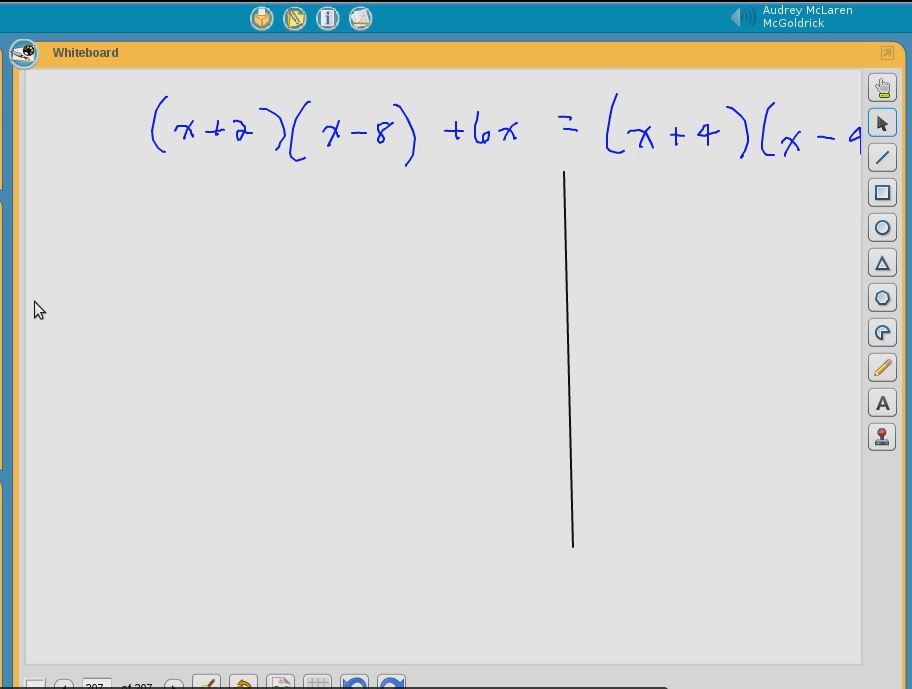
(x + 2)(x - 8) + 6x = (x + 4)(x - 4)

Them: ........

Me: What's the matter? Why isn't anyone answering me? 

Them: We're working on it.... (Students' likely subliminal message: Geez Miss, take a pill.)

Me: Oh this one isn't quite so obvious, eh? How come? (What's the difference between this one and the last one?)

Them: Because there's more steps. 

Me: Well how about this: Susie you simplify the LHS, Johnnie, you do the RHS, and we'll see what happens: 
(Two different people = the two sides are being done completely independently of each other - again, this ain't no equation being solved)

Susie: My side comes to x² - 16
Johnnie: My side comes to x² - 16
Them: It was true!

Me: How does that mean it was true? (Even when both sides got algebra-ed, if LHS = something, and RHS = that same something, then LHS = RHS? Sure about that?)

Them: Both sides came to the same thing, so they must have been equal. Like "this equals that". (Students' likely subliminal message: Isn't that just common sense?!?)

Me: Susie and Johnny, while you were doing your side, did you have to look at the other side in order to proceed?  

Susie and Johnny: Nope. But I did at the end. (The only reason to check the other side is to see if it's the same)

Me: Great! Now how about this:


Them: ........true?

Me:  Ah but I didn't ask you this time if it was true or false......in fact, simply by using the word "Prove", I'm already telling you that it's.....

Them: ...that it's true? ....(it's not about deciding true or false, it's about convincing by using other things we already know to be true, like algebra, trigonometry, and common sense....)

Me:  Right! But now explain to me why you thought it was true.....

We then did the above really simple example together, then off they went in their groups to do harder ones. I caught a few egregious algebra crimes and nipped them in the bud, and gave some groups harder ones to sink their teeth into, so it was a good opportunity for differentiation.

I plan to have them submit three proved identities on their blogs later this week. If I got my message across, I'll see proofs, rather than autopilot solving. More later!

If you have had success in helping your students with trig identities, or if you have your own subliminal messages to share, please do!

(This was also posted at The Flipped Learning Journal.)

Sunday, March 31, 2013

The Big Beautiful Blur

I have done to my flip-o-graphic pretty much the same thing I've been doing to my lessons, which is chopping it up. There seems to be no end to the number of phases one goes through in the flip, and it just makes more sense to have fewer shorter graphics than one ginormous one. I'm also prettying it up a bit, because since I created the first one, I have discovered the pie tool in powerpoint....oh how much time that would have saved me....

These phases are not measured in time, mind you. They are measured in what I call Flip-ages.

Flip-age 1: The most basic flip
I think I was in this phase for about a month or so, maybe even less:


I jumped in whole hog right away, mainly because I had all kinds of lessons in powerpoint format at the ready. I didn't change them much before transforming them into recorded lessons. I just uploaded those puppies to voicethread. The thing is, all those powerpoints were designed as in-class lessons, and had plenty of opportunities for students to be active, like warmup activities, guided note-taking, and examples. So my first flip-ees did all of that too, which meant that they really needed something like an hour to watch the voicethread and do all the writing that accompanied it. Those critics who said flippers were just off-loading drudgery onto the student's evening time? They were, to some extent, right. Mean, but right.

Flip-age 2: In which I stopped being the most important player in my class

This is also where the biggest transformation happened, the one that I still think was only possible, for me, by flipping, and rescuing the f2f time:


This phase, for me, was all about what to do during class. I spent a lot of time reading about Ramsey Musallam's Explore-Flip-Apply, Crystal Kirch's WSQ, Stacey Roshan's techie musings, Kate Nowak's everything, Andy Schwen's everything, John Golden's geogebra stuff, Dan Meyer's three-act-math tasks....so many blogs by so many greats. I've experimented with lots of their ideas and I've also written quite a lot about my experiments in f2f time, and of course, it's an ongoing process. This year I aimed for creating activities that are collaborative, engaging, and fun, as well as strategies for helping students - those that ask for help as well as those who don't. I can't say that this phase is over, but a new flip-age is dawning nevertheless....

Flip-age 3: The Big Beautiful Blur:

And now it's all about the emerging overlap and interactivity of the three sectors:


Now the lesson and the activity are becoming one and the same thing, students' questions are shaping the lesson, or help arises as a natural consequence of an activity. I seem to spend almost as much time gathering, organizing, and responding to student feedback as I used to spend making those 100-slide powerpoints. Yes, that's right. One-hundred. Sorry, students of my past, especially my first flip-ees.

And the next flip-age? 

I hope it will have something to do with learning and assessment that is initiated by my students. Maybe, maybe, it won't fit into this flip-o-graphic, and I'll have to come up with something in three dimensions. Maybe I'll have to use Minecraft to create it, and I'll have to get my own son to teach me how!

Teaching vs. Telling - Do Tell!

As the lines between teacher and student have blurred in my class, so too have the lines between lessons and activities. I find myself trying to reduce, as much as possible, both the length of my recordings and the very necessity of sending my students off to watch them. I'm starting to feel that my recorded lessons are a kind of cop-out on my part, as if by delivering info that way, I'm saying, I can't think of a better way to teach this than by just telling it to you.

I'm just talking about myself here, so please don't take this as a criticism of anyone else. I am truly struggling with this, and maybe I will come to a realization that you already have, that maybe it's a bit unrealistic to think that some day I'll be able to "teach without telling" all year. And anyway, I really have no idea how anyone with a fixed curriculum and a limited amount of time, which is pretty much every high school teacher in the world, would realistically do that. So for the time being, I'll settle for minimizing the passive learning and maximizing the active learning as much as possible. On the other hand.....

Maybe, sometimes, telling is okay!

For example, after you've made your students think, struggle, discuss, compare, and wonder, then it's okay to tell them what's what, or at least better than if you just told them at the outset. I've always felt that it's okay after you've made them sort of suffer a bit, because then they appreciate the relief your facts offer them.

I think I did a pretty good job of that this year in my trig functions unit. I completely rearranged things, and eliminated a few "lessons" at the outset, by having them graph the trig functions without knowing they were trig functions, and without any preconceived idea of what the curve would turn out to be. Once they'd done their graphs, they compared with their peers, and I actually heard them wondering - Is this what it's supposed to look like? Why does it look like this? What kind of math operation would give this kind of curve?

They decided that the wave was the right one, and I told them, yes that's right, and then moved on to explain how trig gets into the act. Next year, I'll try to coax that out of them somehow. But it felt right to validate their intuitions at that point. They were not passively absorbing information at that point - they were primed and very ready to receive it.

I think it's also okay to "tell" once the right question has been asked. In my second year of teaching, I remember having a breakthrough during one of my classes. WARNING: THERE WILL BE MATH!

The Secret to the Good Split

I was doing the grade 9 factoring unit, and we had just finished factoring by grouping, wherein

this:                                                              2x² + 2x + 3x + 3

becomes this:                                               2x(x + 1) + 3(x + 1)

which then factors into this:                              (x + 1) (2x + 3)

From there we went to factoring trinomials like this:

                                                                   2x² + 5x + 3

which can be done by splitting the middle term like this:

                                                                  2x² + 2x + 3x + 3

so that the grouping can be done as above. But the thing is, you have to split that "5x" just the right way, otherwise, the grouping doesn't work. There are plenty of bad splits (eg 4x + 1x would be a bad split), but only one good split, and you could sit there and try them all until you hit the good one, or....you can use the secret!

I remember deciding to myself, right there in front of my class, that I wouldn't tell them the secret until someone asked me. So I just kept putting examples on the board, taking their suggestions for the split and working through the example. Sometimes they hit on the right one right away, and sometimes, happily, they did not. Finally, one student, Richard, sensed that I knew more than I was letting on, and asked The Question. "Miss, how do you know how to split it?"
Before The Secret - Trial and Error
Well, that was the right time to tell them, no? They, or at least Richard, had fallen into my teacher-trap. He had completed an intellectual journey, and deserved the pot of gold, which was the secret to the good split. I suppose that I could have justified it by then challenging someone to find out exactly why the secret works....maybe if I teach grade 9 again someday, I'll do that!

Reality check:

So as much as I'm trying to stop telling, I suspect there is a time for it. And I don't think we should just fall back on the old argument "Well, if we don't, someone else on the internet will, so what the heck?" I am also, like a lot of people, dazzled by the prospect of my students answering their own questions, and self-validating to boot, to become completely self-sufficient.

But is that an unrealistic goal to set everyday? And is there a place for telling?

What do you think? I would really love to know.

PLEASE TELL ME!